Find Treatment By
Rehabs by Location


Learn
About Us
Recovery.com combines independent research with expert guidance on addiction and mental health treatment. Our mission is to help everyone find the best path to recovery through the most comprehensive, helpful network of treatment providers worldwide.
Advisory Council
Our advisory council brings together leaders in behavioral health, technology, and business. Their diverse expertise ensures our resources and product are innovative, evidence-based, and effective. They guide our mission as accomplished individuals dedicated to improving the landscape of addiction recovery and mental wellness.
Addiction Recovery Statistics 2026: What Helps People the Most


What actually helps someone stay in recovery?
This year, we surveyed my email community of over 16,000 people in recovery and their loved ones to share what actually helps, what still feels hard, and what they wish more people understood about the recovery journey.
We received 508 responses. Respondents included people at every stage of recovery, some years into their journey, others just beginning, along with partners, parents, and children supporting someone they love. The survey covered topics ranging from the recovery practices and support systems that help most, to the everyday challenges people are still managing, to how people prefer to consume recovery-related content.
The result is a snapshot of recovery as it's actually lived, not just as it's clinically defined.
Recovery Topics That Resonate Most
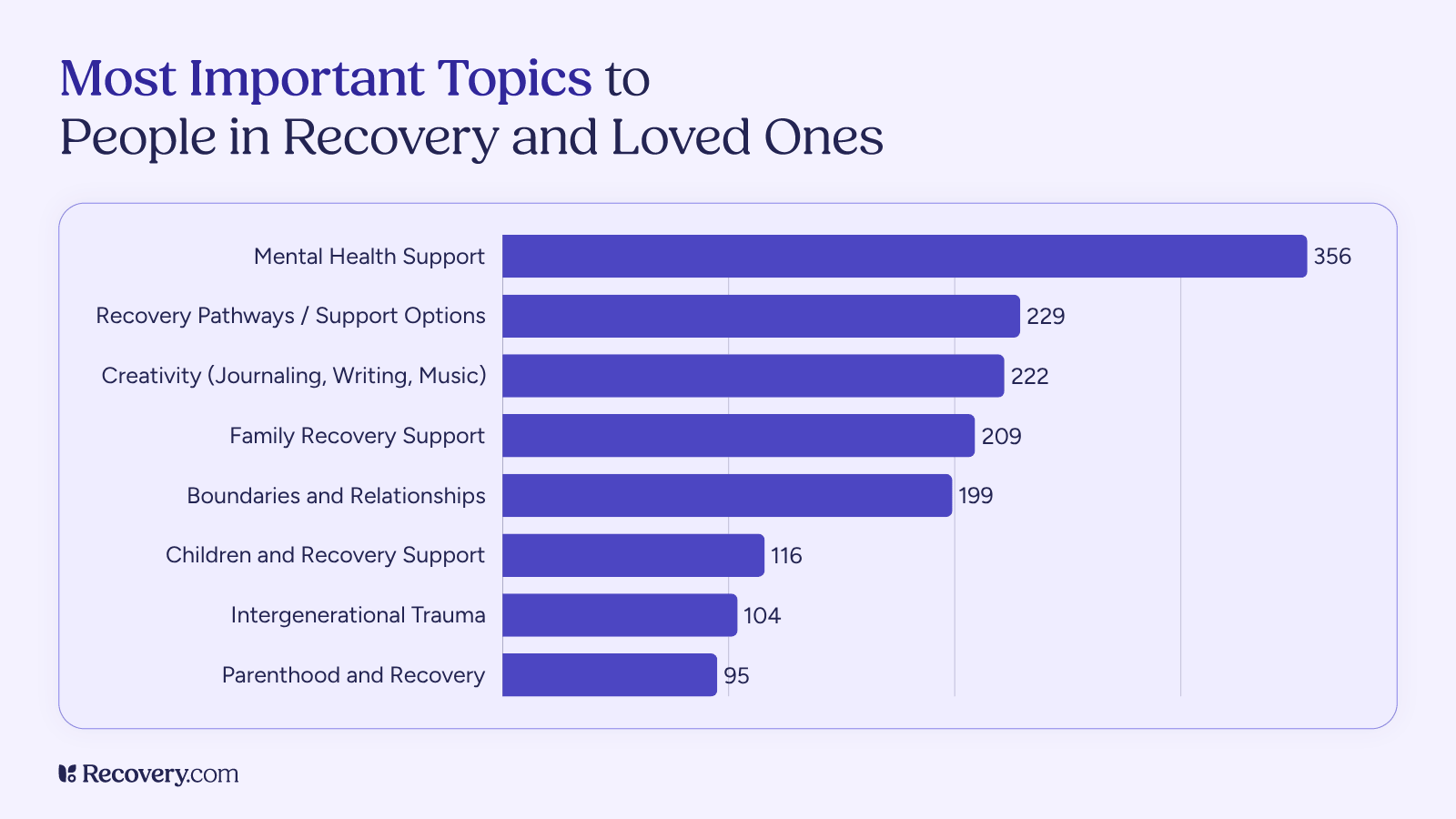
When we asked which topics mattered most, mental health support rose to the top, followed by recovery pathways, creativity, and family support. The results reflect what many of us know through both research and lived experience: substance use rarely exists in isolation.1 Anxiety and depression in early recovery, trauma, and complicated family relationships are often part of the story, and they deserve the same care and attention as substance use itself.
Most People Feel Like They're Growing
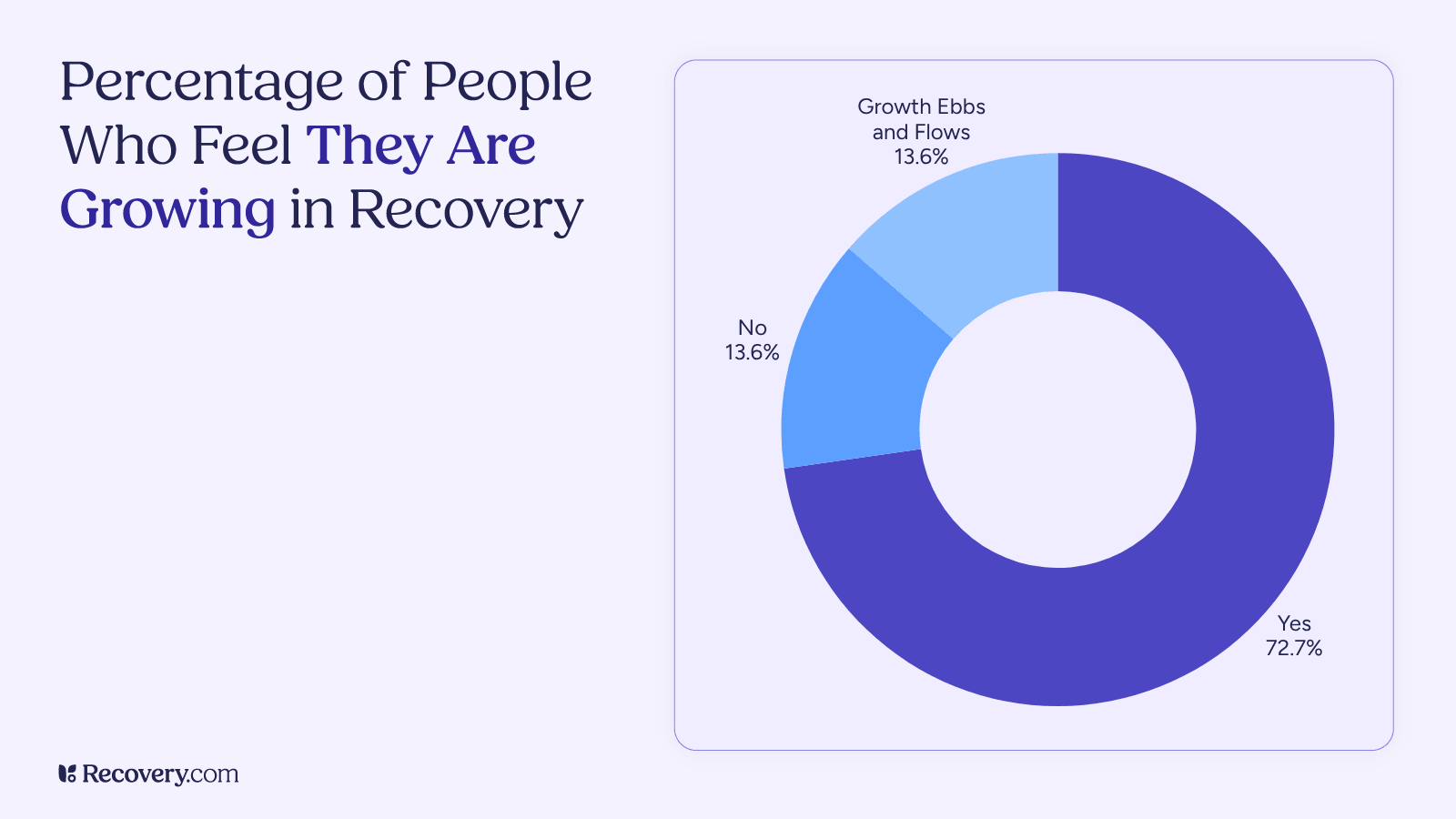
Nearly three-quarters of respondents said they feel like they are growing in their recovery, and that is deeply encouraging. For those who do not feel that way right now, growth is still possible. Recovery is not linear, and progress does not always feel steady or visible. It can ebb and flow with different seasons of life. Sometimes growth looks like moving forward. Other times, it looks like staying connected, asking for help, or simply continuing to show up.
If you're looking for more ways to build this into a daily routine, we've gathered ideas for how to practice self-compassion in recovery.
The Everyday Challenges People Are Managing
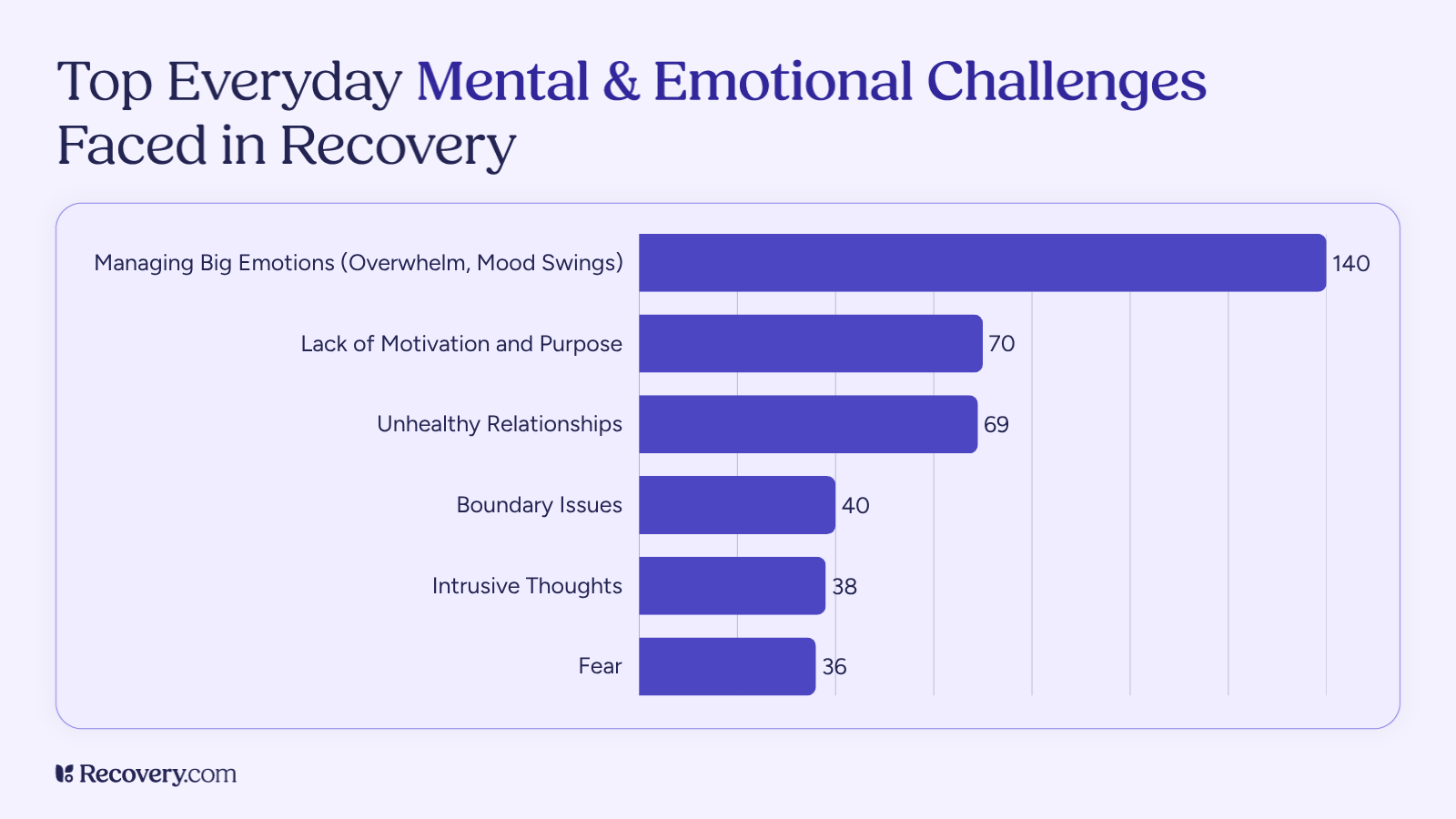
Emotional challenges topped the list of ongoing struggles, reported by more than one-third of respondents. A lack of motivation or purpose and unhealthy relationship patterns followed closely, along with difficulties related to boundaries, intrusive thoughts, and fear.

For those of us who work in the recovery field, these findings may feel familiar. Still, they offer an important reminder: recovery is about far more than staying sober or managing symptoms. It is also about learning to move through difficult emotions, rediscovering purpose, and changing relationship patterns that may have taken shape long before substance use or mental health challenges began. Managing mental health and addiction recovery together, rather than as 2 separate journeys, is often what this stage of the work is really about.
Dealing with negative thoughts in recovery is one of the most common things people describe once the initial fog lifts.
What Actually Helps: The Keys to Lasting Recovery
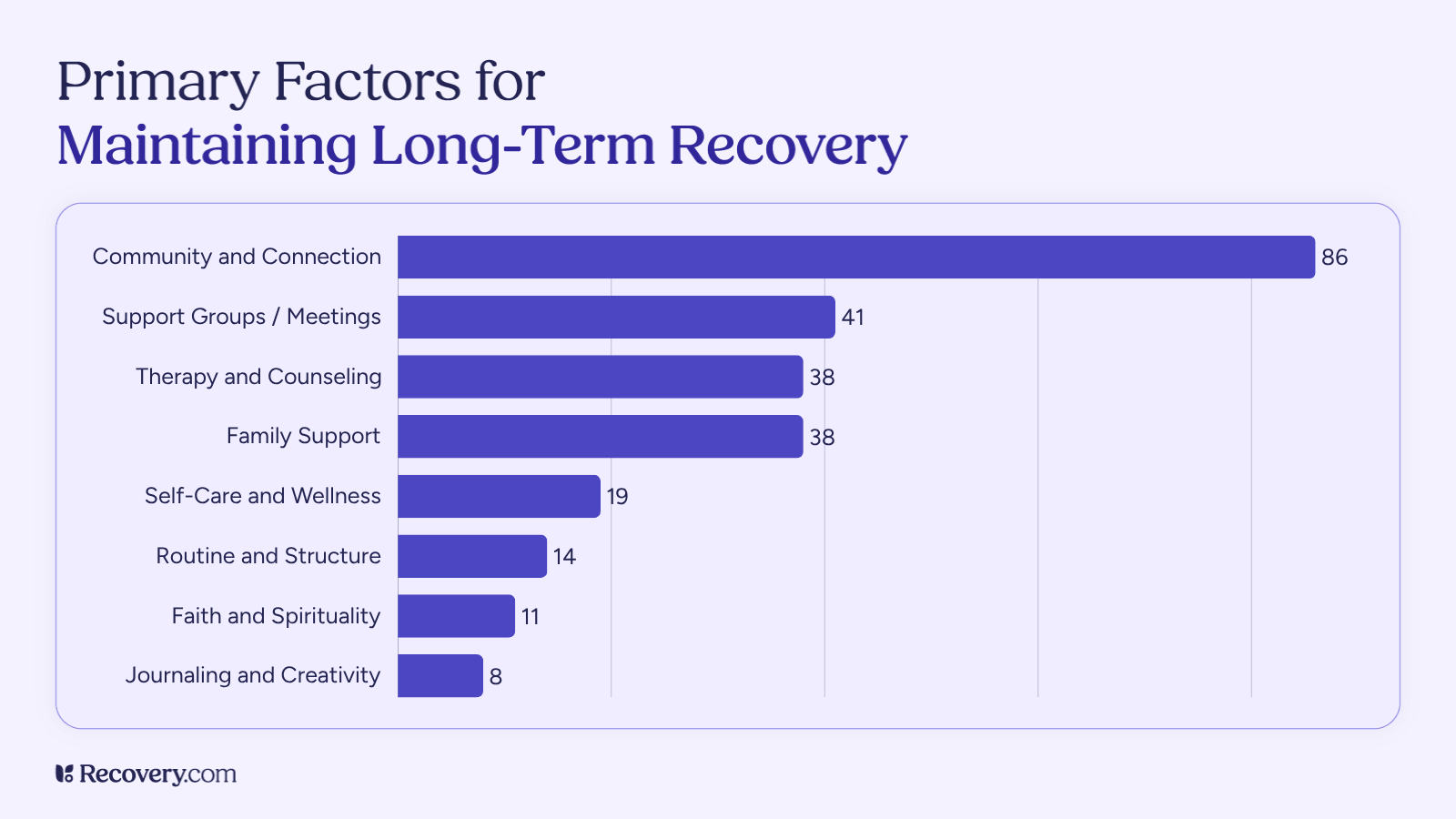
When asked what's most beneficial for maintaining a successful recovery, one answer stood far above the rest: community and connection. Support groups and meetings, therapy and counseling, and family support followed, with self-care, routine, faith, and creative outlets rounding out the list.
This lines up with decades of recovery research. Isolation is one of the biggest predictors of relapse or recurrence of use, and connection, in whatever form it takes, is one of the strongest protective factors against it.2 Understanding how isolation affects recovery is part of why we keep coming back to community as the answer people give most often.
The Most Helpful Part of the Journey So Far
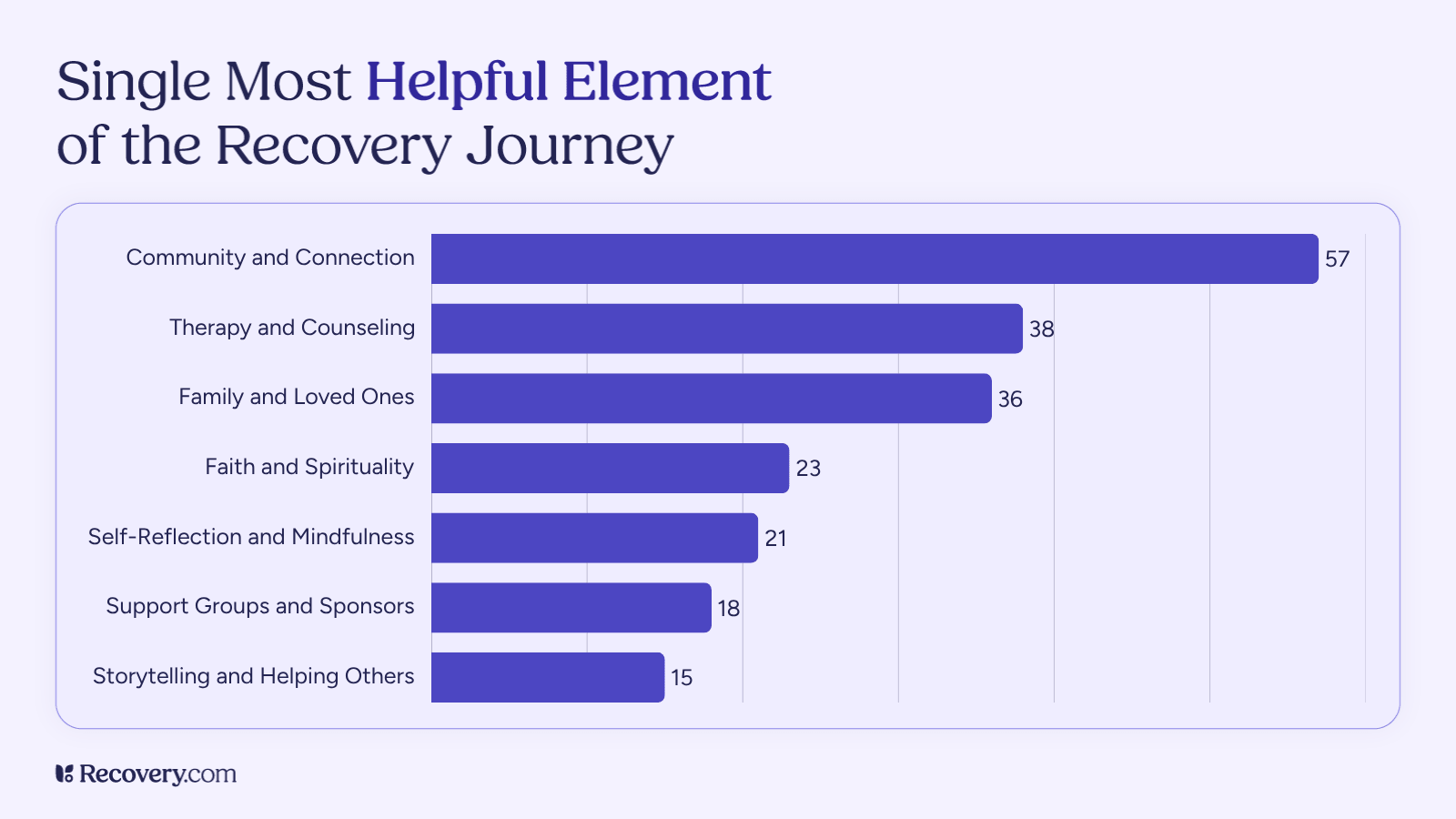
When respondents reflected on what has helped them most in recovery, community and connection rose to the top once again. Therapy and counseling, rebuilding relationships in recovery with family and loved ones, faith and spirituality, and honest self-reflection also played important roles.
A smaller but meaningful group named something deeply connected to recovery: sharing their stories and helping others. Sometimes healing grows as we give language to what we have lived through and use it to remind someone else that they are not alone.
Where People Say They're Still Struggling
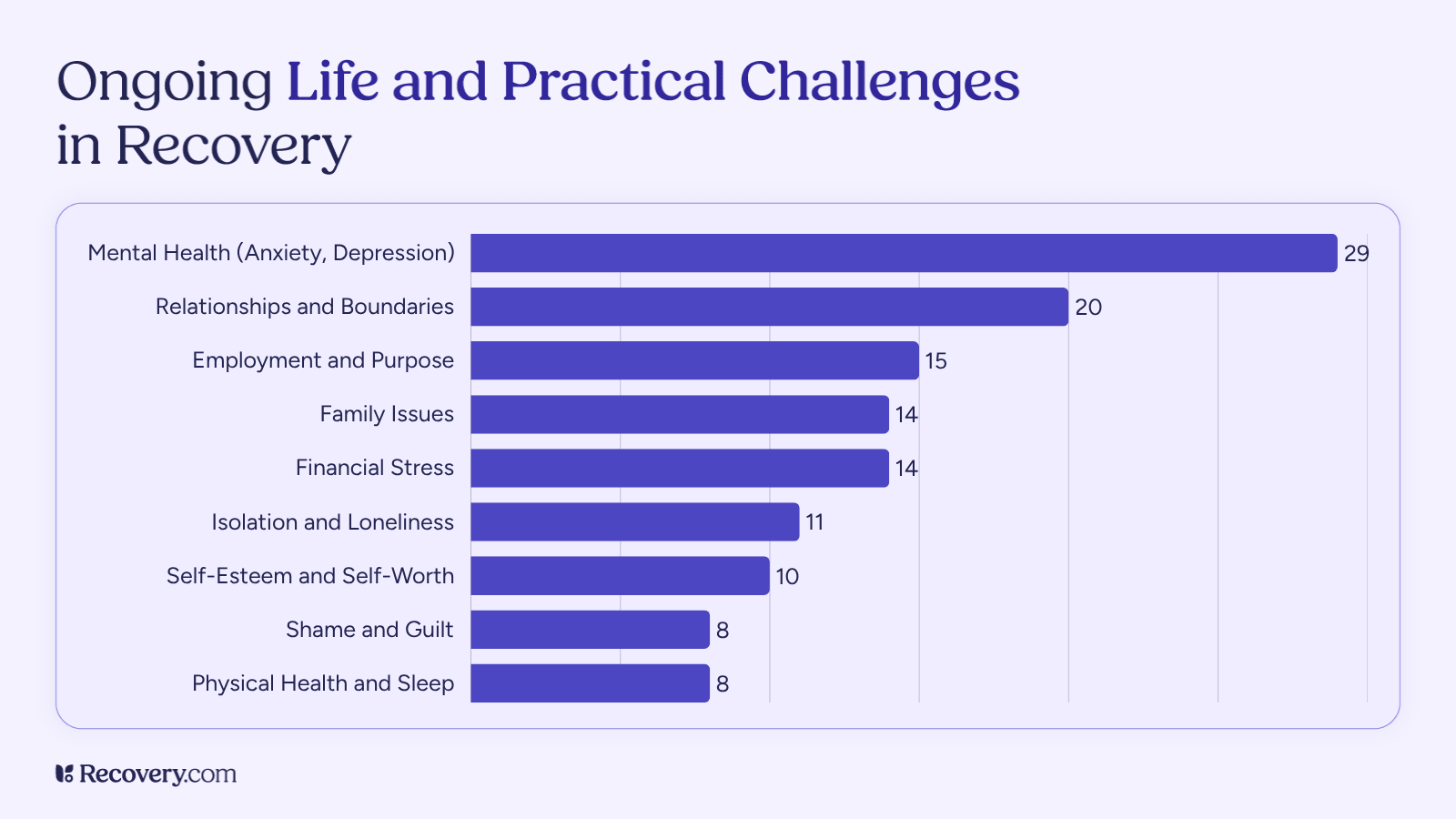
Anxiety, depression, and other mental health challenges rose to the top, followed closely by struggles with relationships and setting boundaries in recovery. Respondents also named the everyday pressures that can make recovery feel especially heavy: finding meaningful work, finding purpose after addiction, navigating family relationships, and managing financial stress. Isolation, low self-esteem, shame, guilt, and physical health concerns also surfaced, reminding us that recovery touches every part of a person's life.
It's worth pausing over how often financial stress and employment struggles appeared. Recovery doesn't happen in a vacuum. Paying rent, finding meaningful work after rehab, and rebuilding trust are not separate from recovery. These everyday realities can either strengthen someone's foundation or make it much harder to stay connected to the healing they've worked so hard to build.
The Strengths People Lean On
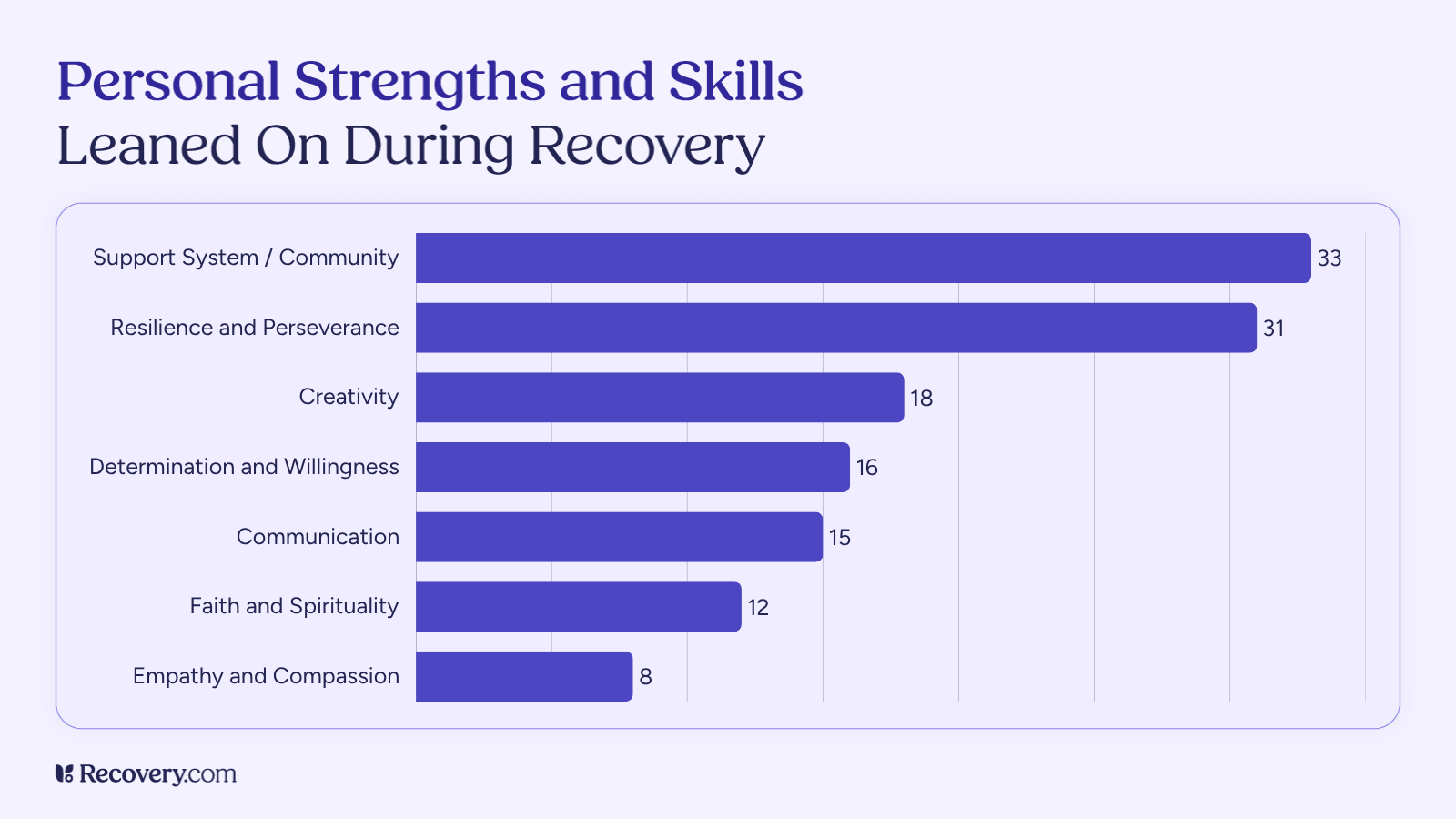
When asked what strengths they bring to their recovery, respondents most often named their support systems and sense of community, followed closely by resilience and perseverance. Creativity, determination, communication skills, and faith also rose to the surface. It's an important reminder that people in recovery are not simply working through challenges. They are drawing on hard-earned strengths, meaningful relationships, and real skills every day.
Daily Reflections and Affirmations Are Popular
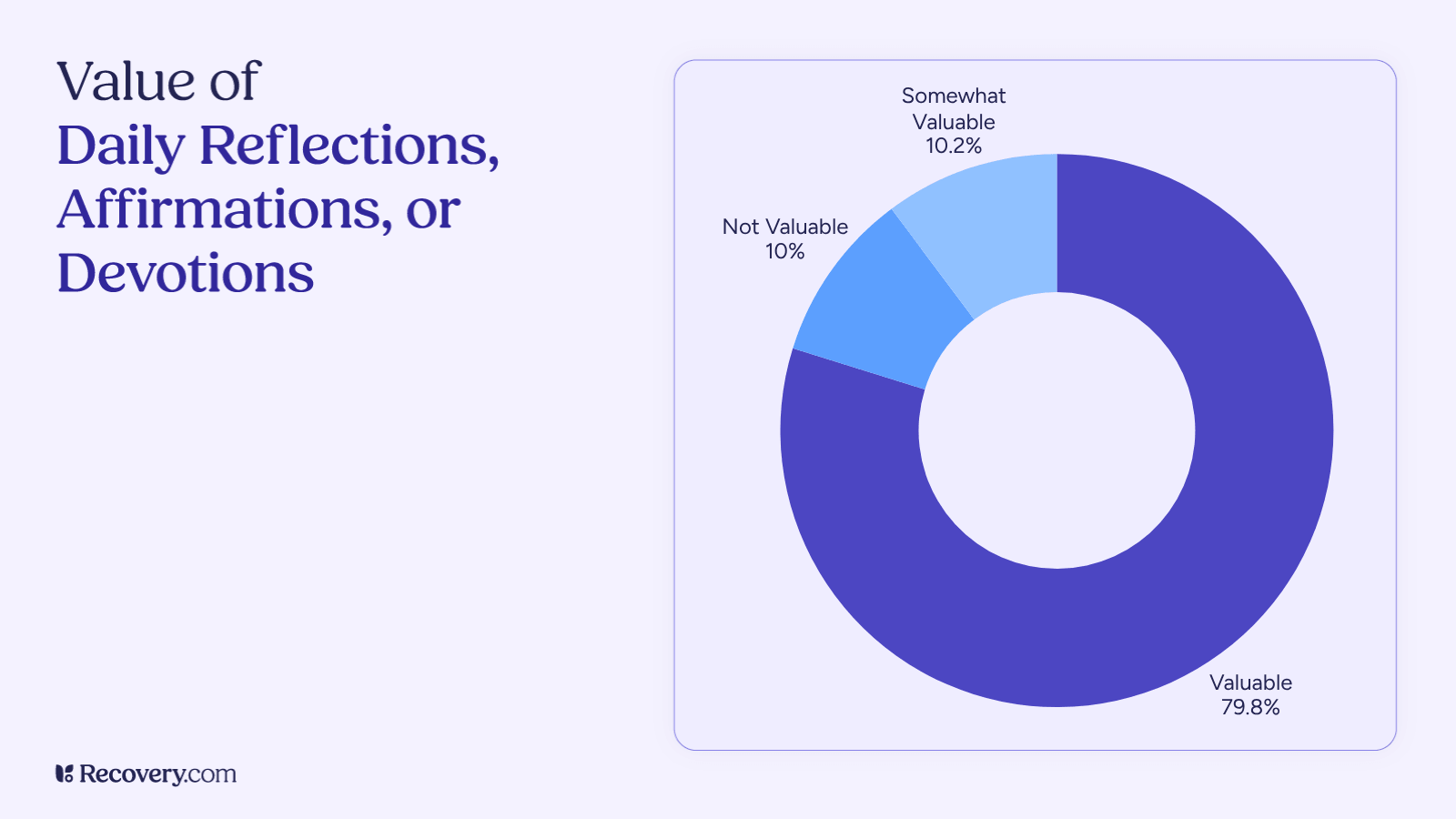
A strong majority, more than three-quarters of respondents, said they find daily reflections, affirmations, or devotions helpful in their recovery practice. Only a small share said no. For a field that's often focused on big milestones and major turning points, this is a good reminder that small, daily practices carry a lot of weight too. Many people build their own daily affirmations for recovery, journaling prompts, or short devotionals into a morning or evening routine.
People Want to Share Their Stories
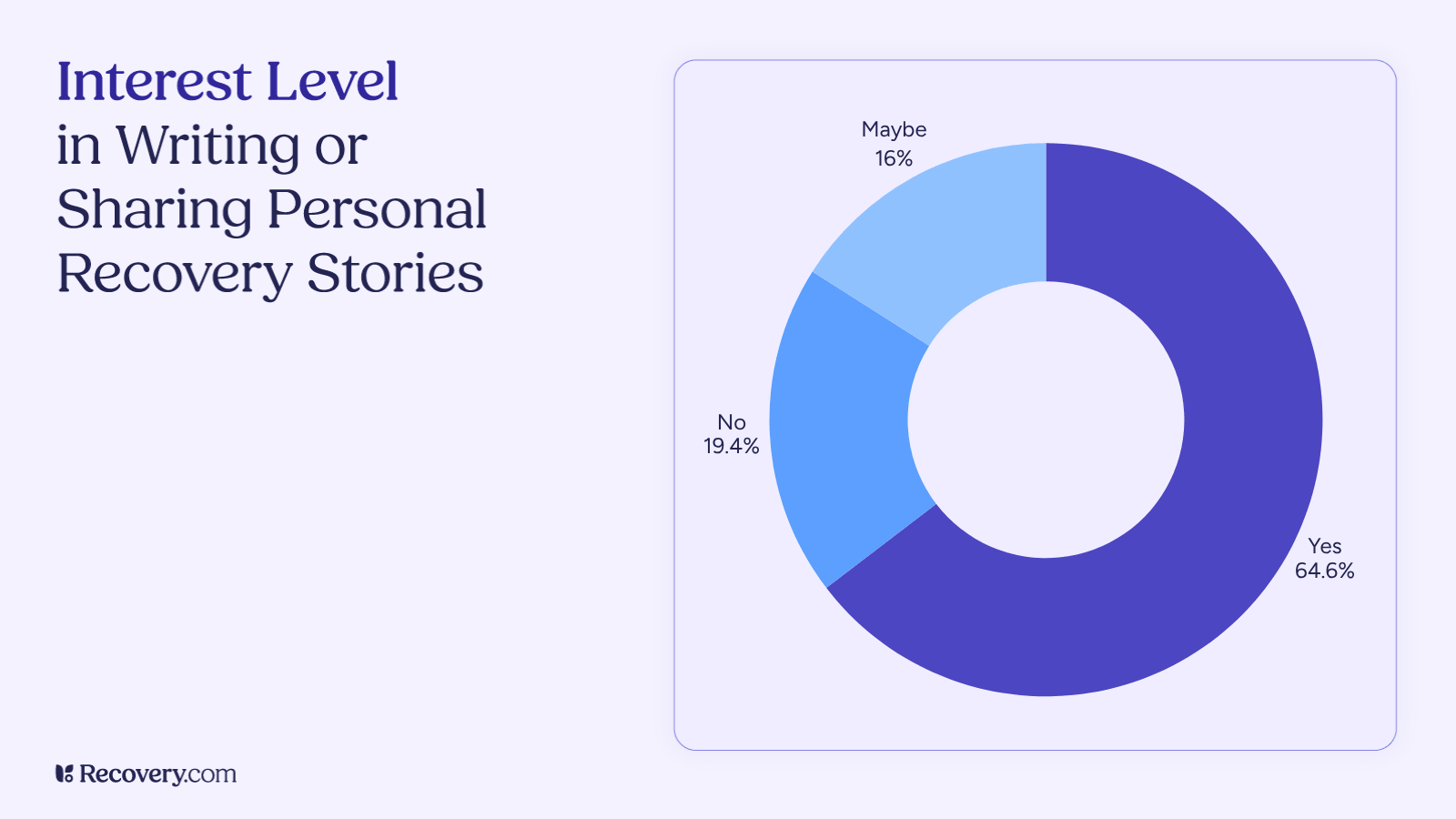
A notable majority of respondents said they're interested in learning more about sharing or writing their own recovery story, with only a small share saying no outright. That's a meaningful signal. Storytelling is one of the most powerful tools in recovery, both for the person telling it and for everyone who reads it and feels a little less alone. The benefits of sharing your recovery story go both ways: it can reduce stigma for the person telling it and offer hope to the person hearing it.
How People Want to Receive Recovery Content
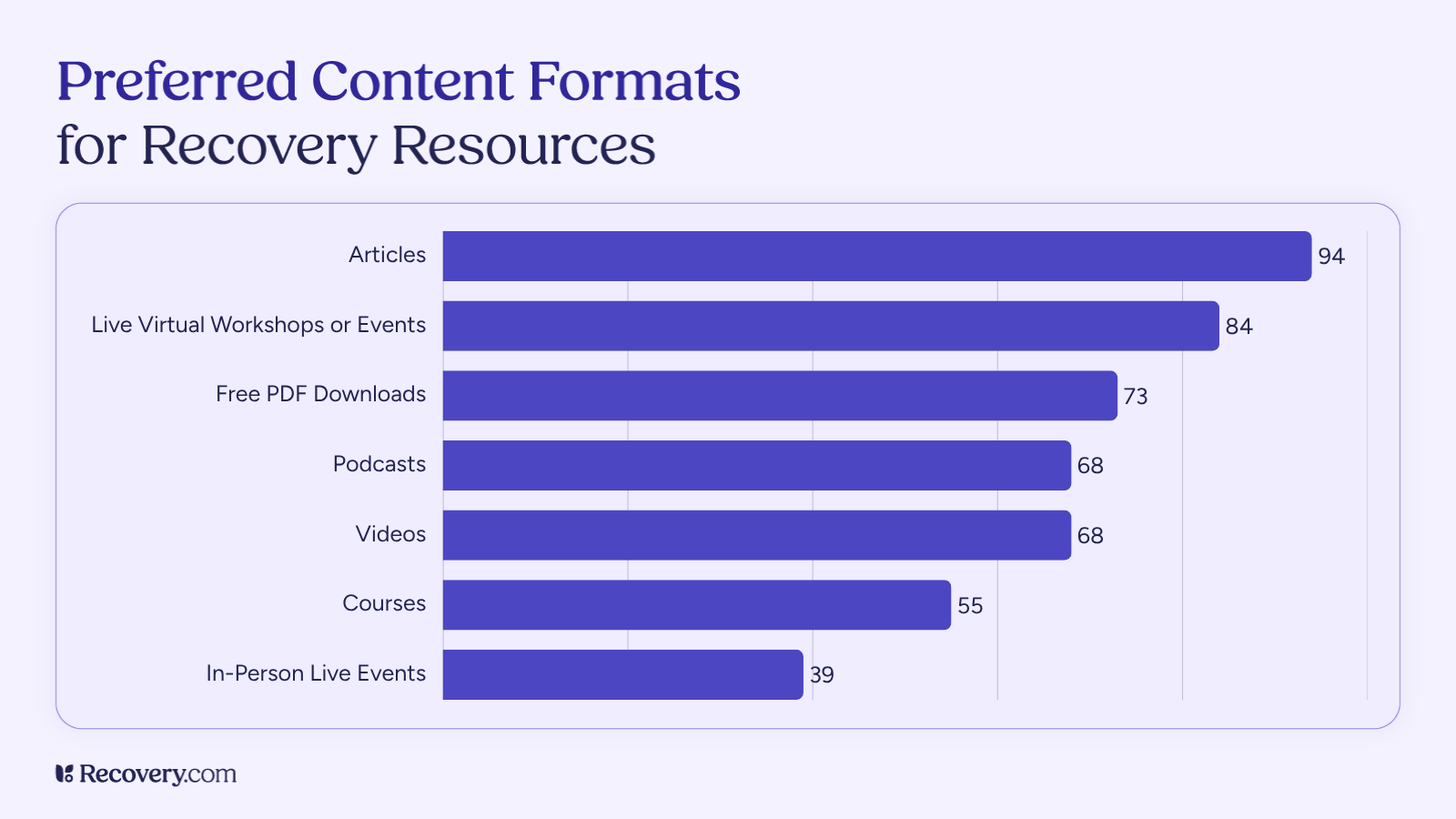
Articles remain the preferred way to engage with recovery-related content, followed closely by live virtual workshops and events, free downloadable resources, podcasts, and videos. Courses and in-person gatherings also have an important place. The message for those of us creating content in this space is clear: people learn, connect, and grow in different ways. Offering a variety of formats helps more people find the support they need in a way that works for them.
Find The Perfect Treatment For You
Answer a few questions and we'll match you with the best options.
What Are You Struggling With?
What Kind of Care Do You Need?
What Insurance Do You Have?
Summary of Findings
Taken together, these 2026 addiction recovery statistics tell a consistent story. People in recovery, and the loved ones supporting them, overwhelmingly point to connection as the single biggest factor in maintaining a successful recovery.
- Community outranked therapy, faith, routine, and self-care combined in more than 1 question.
- Nearly 3 in 4 respondents feel they're growing in their recovery, though growth rarely feels linear or easy.
- Mental health support is the topic that resonates most, ahead of recovery pathways, creativity, and family support.
- Community and connection is named the single most beneficial factor for maintaining recovery, and the most helpful part of the journey overall.
- Financial stress and employment struggles rank alongside mental health and relationship issues as the biggest ongoing challenges.
- More than three-quarters of respondents find daily reflections or affirmations helpful, showing small, consistent practices matter as much as big milestones.
- A strong majority want to learn more about sharing their own recovery story.
- Articles and live virtual events are the most preferred ways to receive recovery content, though preferences are spread across many formats.

Implications for the Behavioral Health and Treatment Fields
These findings offer a few clear takeaways for treatment providers, clinicians, and organizations working in the behavioral health space.
Connection deserves the same investment as clinical care
Community and connection outranked every other factor for maintaining recovery and describing the most helpful part of the journey. Treatment programs that build in strong peer support, alumni networks, and family involvement are addressing what respondents say matters most, not just a nice-to-have add-on to clinical treatment.
Co-occurring care isn't optional
Mental health support was the single most resonant topic, and emotional struggles, motivation, and intrusive thoughts topped the list of everyday challenges. This reinforces the need for integrated, co-occurring disorders treatment that addresses substance use and mental health together, rather than treating them as separate tracks.2
Practical, social determinants of health matter
Financial stress and employment struggles ranked close to mental health and relationship challenges. Programs and providers who help patients navigate job placement, financial literacy, and housing stability are addressing real barriers to sustained recovery, not just clinical ones.3
Small daily practices have real value
The strong response around daily reflections and affirmations suggests that low-barrier, consistent tools, an app, a daily email, a short devotional, can meaningfully support recovery alongside formal treatment and should be considered part of a comprehensive aftercare plan.
People want to be heard, not just treated
The high interest in sharing personal recovery stories points to an opportunity for treatment centers, publishers, and advocacy organizations to create more platforms for lived experience. Peer storytelling reduces stigma and gives people further along in recovery a meaningful way to give back.
Meet people where they consume content
With preferences spread across articles, live events, podcasts, videos, and downloadable resources, organizations should diversify how they share recovery education and resources rather than relying on a single channel.














What This Tells Us Going Forward
Every question in this survey points back to the same thing: people don't recover alone, and they don't want to. Community outranked therapy, faith, and self-care as the single most helpful part of the journey, not because clinical care matters less, but because connection is what makes people willing to keep using the tools they're given.
There is no single formula for recovery. But there is a clear pattern: community and connection in recovery matter more than almost anything else respondents named. Even when the path looks different for each person, meaningful relationships and a sense of belonging consistently help make recovery possible.
Big thanks to everyone who took the time to share their experience. This kind of honest, real-world feedback is exactly what helps the recovery field keep getting better at meeting people where they are.
Looking for support right now?
You don't have to figure this out alone. Search Recovery.com to find treatment centers, programs, and providers to help you or someone you love take the next step.
FAQs
In our survey, respondents named community and connection as the single most beneficial factor for maintaining a successful recovery, ahead of therapy, faith, and self-care. Isolation is one of the strongest predictors of relapse, so building relationships with people who understand your experience helps you stay grounded and accountable.
No. Nearly three-quarters of survey respondents said they feel like they're growing in their recovery, but many described that growth as uneven rather than a straight line. Progress can ebb and flow with different seasons of life, and a setback doesn't erase the work you've already done.
More than three-quarters of the people we surveyed said daily reflections, affirmations, or devotions are a helpful part of their recovery practice. Small, consistent habits like these build the same kind of stability that bigger milestones do, just at a slower, steadier pace.
Respondents most often pointed to emotional challenges, a lack of motivation or purpose, and unhealthy relationship patterns. Financial stress, employment struggles, and difficulty setting boundaries also ranked high, showing that recovery touches practical life as much as it does mental health.
A strong majority of survey respondents said they're interested in sharing or writing their own recovery story. Storytelling helps reduce stigma, reminds others they're not alone, and can be a meaningful part of a person's own healing process.


Our Promise
How Is Recovery.com Different?
We believe everyone deserves access to accurate, unbiased information about mental health and recovery. That's why we have a comprehensive set of treatment providers and don't charge for inclusion. Any center that meets our criteria can list for free. We do not and have never accepted fees for referring someone to a particular center. Providers who advertise with us must be verified by our Research Team and we clearly mark their status as advertisers.
Our goal is to help you choose the best path for your recovery. That begins with information you can trust.