Find Treatment By
Rehabs by Location


Learn
About Us
Recovery.com combines independent research with expert guidance on addiction and mental health treatment. Our mission is to help everyone find the best path to recovery through the most comprehensive, helpful network of treatment providers worldwide.
Advisory Council
Our advisory council brings together leaders in behavioral health, technology, and business. Their diverse expertise ensures our resources and product are innovative, evidence-based, and effective. They guide our mission as accomplished individuals dedicated to improving the landscape of addiction recovery and mental wellness.
Justice-Involved Recovery: Treatment and Support After Incarceration



In 1976, Operation Understanding broke new barriers and helped change the recovery movement forever. Now, 50 years later, we’re honoring that legacy—and building what comes next.
Part of this effort is sharing the latest evidence-based information on topics that are important to you.
This toolkit was created in partnership with Mobilize Recovery and Recovery.com for Operation Understanding.
Justice-involved recovery combines two ideas: the recovery process itself and the unique path people take through it when the justice system is part of their story. SAMHSA defines recovery broadly as a process of change where a person improves their health and wellness, lives a self-directed life, and works toward their full potential.1 Justice-involved recovery applies that same process to people navigating incarceration, release, or supervision at the same time, whether that means starting treatment while still in jail, continuing care after release, or building a stable life while on probation or parole.
What makes this path distinct is timing and continuity. Treatment that begins during incarceration and continues seamlessly into the community, rather than stopping at release, gives someone the best chance of staying well and staying out of the system.2
A criminal record does not close the door on recovery. Law enforcement, courts, and corrections systems increasingly work alongside treatment providers to connect justice-involved people with substance use and mental health care rather than relying on incarceration alone.1
Why Substance Use and Mental Health Treatment Matter
Substance use disorder and mental health conditions are common among people who come into contact with the justice system, and the two frequently occur together as co-occurring disorders.2 According to a 2016 Department of Justice survey cited in peer-reviewed research, 41% of state and federal prisoners had a history of mental illness, with 27% of state prisoners reporting a major depressive disorder and 22% reporting an anxiety disorder.2
These behavioral health needs often go unaddressed while someone is incarcerated, which is part of why the transition back to the community carries so much risk. Left untreated, both substance use disorder and mental health disorders raise the likelihood of further justice involvement.2
Depression is one of the most common of these conditions among incarcerated people, and it's often diagnosed alongside SUD rather than on its own, which is why treatment approaches typically screen for both together as co-occurring depression and other conditions rather than treating substance use in isolation.2
Find The Perfect Treatment For You
Answer a few questions and we'll match you with the best options.
What Are You Struggling With?
What Kind of Care Do You Need?
What Insurance Do You Have?
Why Language Matters in Justice-Involved Recovery
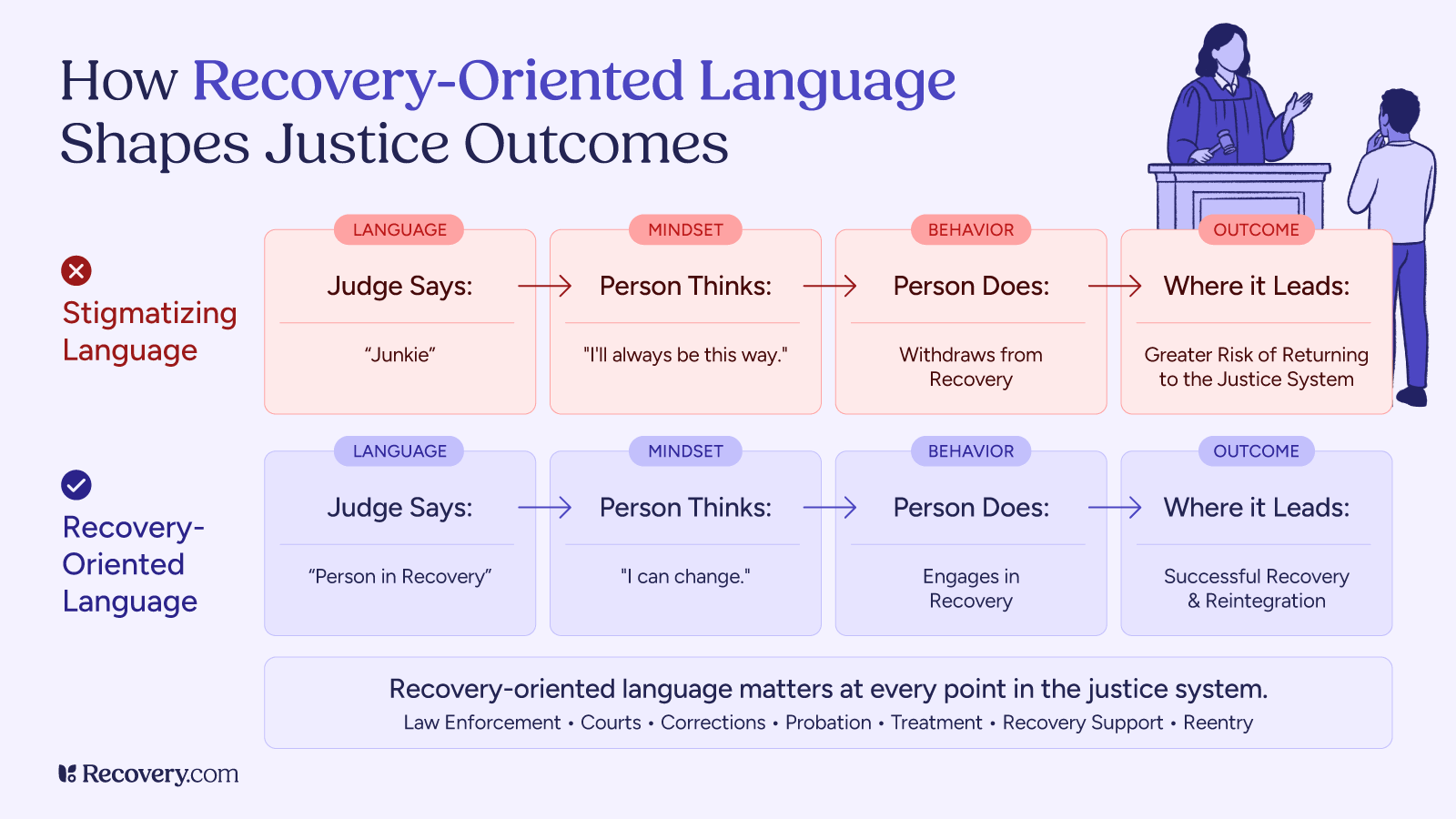
The words used to describe someone can shape how that person sees themselves, and that self-perception affects what happens next. When a judge, officer, or case worker uses a label like "junkie," it can reinforce the belief that change isn't possible, which makes someone more likely to withdraw from treatment and end up back in the justice system.
Person-first language, like calling someone "a person in recovery" instead of defining them by a past label, supports a different mindset: one where change feels possible, engagement in treatment feels worthwhile, and reintegration feels within reach. This isn't just a courtesy. It matters at every point of contact, from law enforcement and courts to corrections, probation, treatment, and reentry.
Explore Justice Involved Treatment Centers
How Recovery and Recidivism Are Connected
The weeks immediately following release from incarceration are the highest-risk period for both relapse and reoffending, largely because reduced drug tolerance during incarceration makes a return to previous use levels far more dangerous.3 A CDC-led review of the research found that the risk of fatal overdose is several times higher in the first two weeks after release than in the weeks that follow, before gradually declining over the following months.3
This reentry window is also when reintegration into housing, employment, and family life is hardest, which is why long-term recovery depends on support that starts before release and continues after it.3 Treatment that continues across the transition from incarceration to the community, rather than stopping at release, is associated with reduced recidivism and lower relapse rates over time.4














Treatment Courts and Alternatives to Incarceration
Many jurisdictions now offer treatment courts, sometimes called drug courts, that mandate and coordinate substance use treatment as an alternative to incarceration for eligible defendants.5 These programs monitor progress in treatment while connecting participants to other services, one of several diversion points within the Sequential Intercept Model that SAMHSA uses to map where people with behavioral health needs can be redirected toward care instead of deeper justice involvement.5
Probation and parole can also include treatment conditions instead of additional jail time, letting someone remain in the community while receiving care. These court-supervised programs go by a few different names depending on how they're structured and who orders them, though in practice the terms are often used interchangeably. When a judge requires treatment as a condition of sentencing, it's often called court-mandated rehab.

A related, and often overlapping, arrangement covers treatment ordered as part of a plea agreement or a formal diversion program before sentencing. Recovery.com's guide to court-ordered rehab covers how that version of the process typically works.
Evidence-Based Treatment Approaches
The most effective, evidence-based treatment approaches for justice-involved individuals combine behavioral therapy with medication where appropriate. The National Institute on Drug Abuse has found these approaches reduce both drug use and recidivism when they continue across the transition from incarceration to the community.4
- Cognitive behavioral therapy helps someone identify the thought patterns that contribute to substance use and criminal behavior, and it remains one of the most studied approaches for this population.4
- Motivational interviewing is another widely used approach in these settings. It helps someone build their own reasons for change, which tends to work better under legal pressure than approaches that rely on external pressure alone, according to NIDA's research.4
- For opioid use disorder specifically, medication-assisted treatment (MAT) pairs FDA-approved medications with counseling and has strong evidence behind it for people leaving incarceration.4 Few correctional facilities currently offer this care on-site, even though the evidence supporting it is well established.4
- Starting or continuing MAT for opioid use disorder directly in a jail or prison setting, before someone is released, improves the odds that treatment continues without a gap.4
Reentry Support and Continuity of Care
Continuity of care, meaning treatment started during incarceration continues without interruption after release, is one of the strongest predictors of a successful reentry.6 Case management connects someone to a single point of contact who can coordinate behavioral health services, housing, and other reentry needs both before and after release.6
Reentry services also include help with benefits and identification paperwork, transportation to appointments, and warm hand-offs from corrections staff to community-based providers, so someone doesn't leave custody without a plan already in place.6 Care coordination across corrections, treatment providers, and community organizations helps close the gaps where people are most likely to fall out of care.6
Peer support groups, often led by people with their own history of recovery or justice involvement, can also help ease the isolation many people feel in the first weeks after release.

Paying for Treatment: Medicaid and Coverage
Medicaid eligibility doesn't have to end when someone is incarcerated. States are increasingly moving toward suspending Medicaid coverage during incarceration rather than terminating it, which allows coverage to resume quickly once someone is released instead of requiring a new application.6
Where this suspension policy is in place, someone can leave custody with active health coverage for medication, therapy, and other treatment already in effect.6 For anyone without Medicaid, or navigating other coverage questions, Recovery.com's guide on paying for rehab breaks down insurance, financing, and assistance options in more detail.
Justice involvement does not have to define someone's path forward. Whether someone is currently incarcerated, newly released, or several years into supervision, treatment for substance use disorder and mental health works, and support exists at every stage, from arrest through long-term recovery. Reaching out to a treatment provider, case manager, or community organization is often the first step toward finding the right level of care.
How Recovery.com Can Help
Recovery.com is a free, impartial treatment navigation platform that helps people find evidence-based addiction and mental health care quickly, with clinically reviewed content, transparent center profiles, and tools designed to enhance treatment access.
This toolkit was created in collaboration with Mobilize Recovery for Operation Understanding.
FAQs
Justice-involved describes anyone with contact with the criminal justice system, including people who are currently incarcerated, formerly incarcerated, or under supervision such as probation or parole.1
Incarceration doesn't cause a disorder on its own, but people who have been arrested or incarcerated report substance use and mental health concerns, including depression, at much higher rates than the general population, and those needs often go unaddressed while someone is in custody.2
A drug court, or treatment court, is a specialized court program that mandates and coordinates substance use treatment as an alternative to incarceration, monitoring a participant's progress instead of relying solely on jail or prison time.5
Yes. Medication-assisted treatment, particularly when started during incarceration and continued after release, is one of the most evidence-based approaches for reducing both drug use and reoffending in this population.4
The first two weeks after release carry the highest risk of relapse and fatal overdose, largely due to reduced drug tolerance, so continuing treatment that started during incarceration and having a reentry plan in place before release both meaningfully lower that risk.3
Medicaid coverage can continue through incarceration in states that suspend, rather than terminate, eligibility, which allows coverage for treatment and medication to resume quickly at release instead of requiring a new application.6

Our Promise
How Is Recovery.com Different?
We believe everyone deserves access to accurate, unbiased information about mental health and recovery. That's why we have a comprehensive set of treatment providers and don't charge for inclusion. Any center that meets our criteria can list for free. We do not and have never accepted fees for referring someone to a particular center. Providers who advertise with us must be verified by our Research Team and we clearly mark their status as advertisers.
Our goal is to help you choose the best path for your recovery. That begins with information you can trust.