Find Treatment By
Rehabs by Location


Learn
About Us
Recovery.com combines independent research with expert guidance on addiction and mental health treatment. Our mission is to help everyone find the best path to recovery through the most comprehensive, helpful network of treatment providers worldwide.
Advisory Council
Our advisory council brings together leaders in behavioral health, technology, and business. Their diverse expertise ensures our resources and product are innovative, evidence-based, and effective. They guide our mission as accomplished individuals dedicated to improving the landscape of addiction recovery and mental wellness.
“Just Ask for Help”: A Report on Unanswered Calls to Treatment Providers


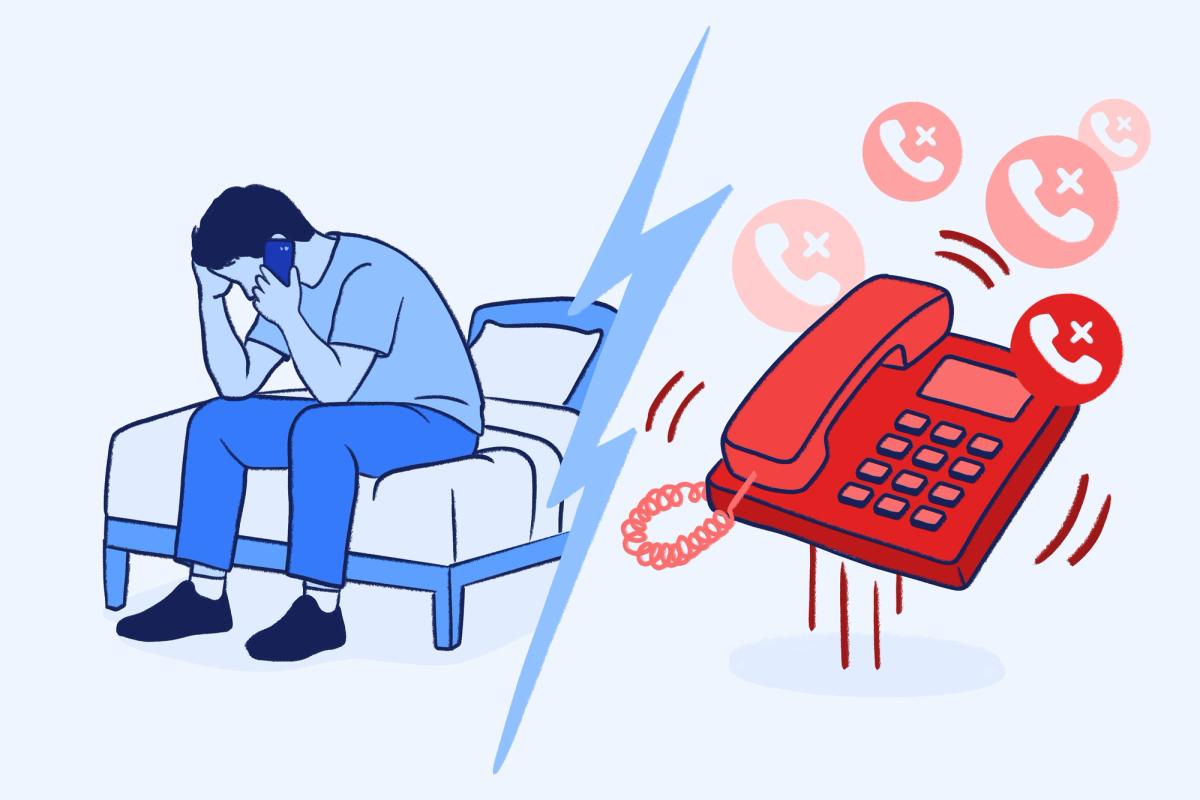
Advice for those facing an addiction or mental health condition is simple: just ask for help. But when they ask, do they receive?
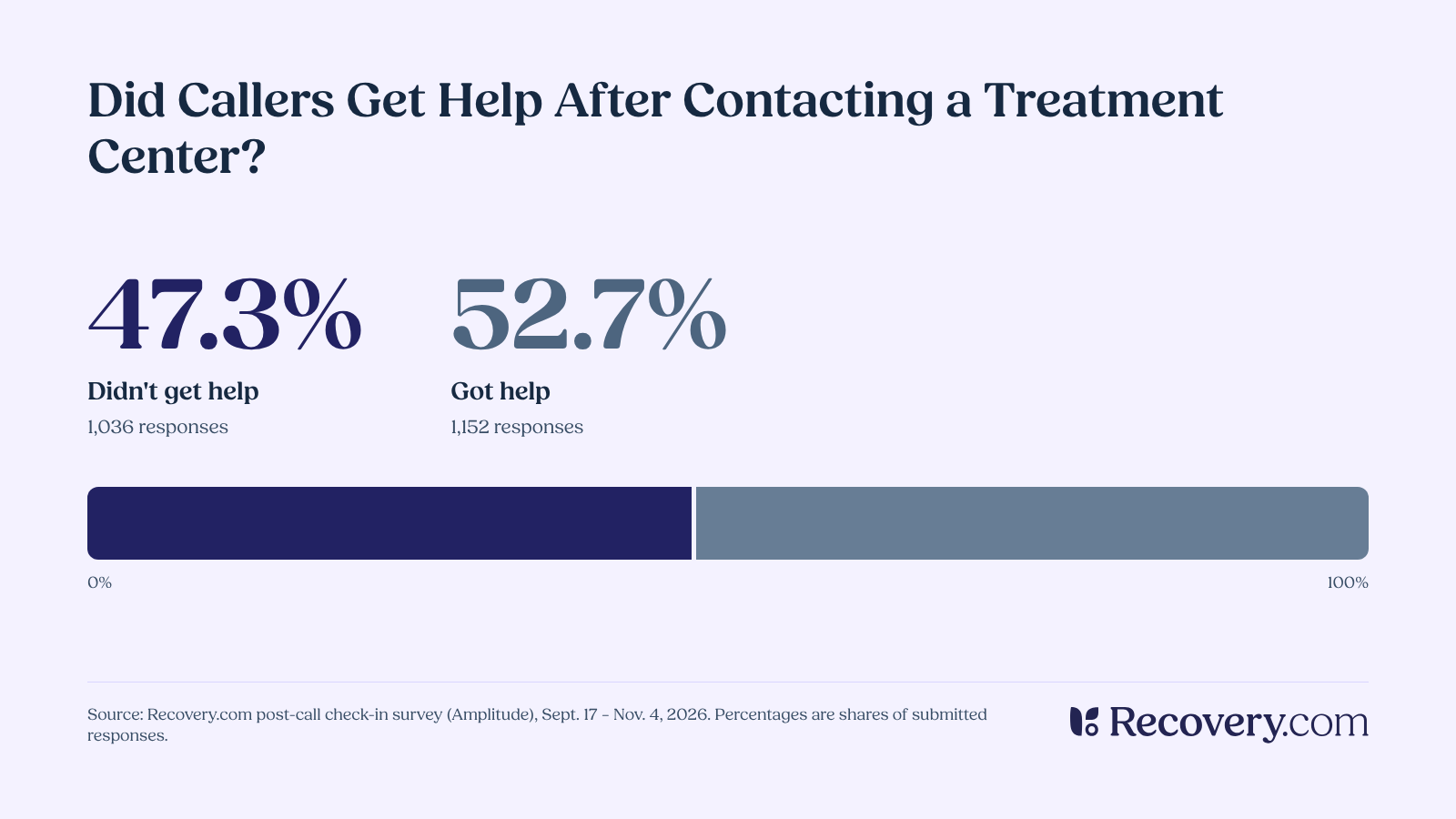
A post-call survey on Recovery.com asked people who called a treatment center if they got the help they needed. Almost 50% of respondents reported that they didn’t get help after calling. They were given a few options to explain why, including that the program was too expensive, too far away, or just not the right fit. None of those were the most common.
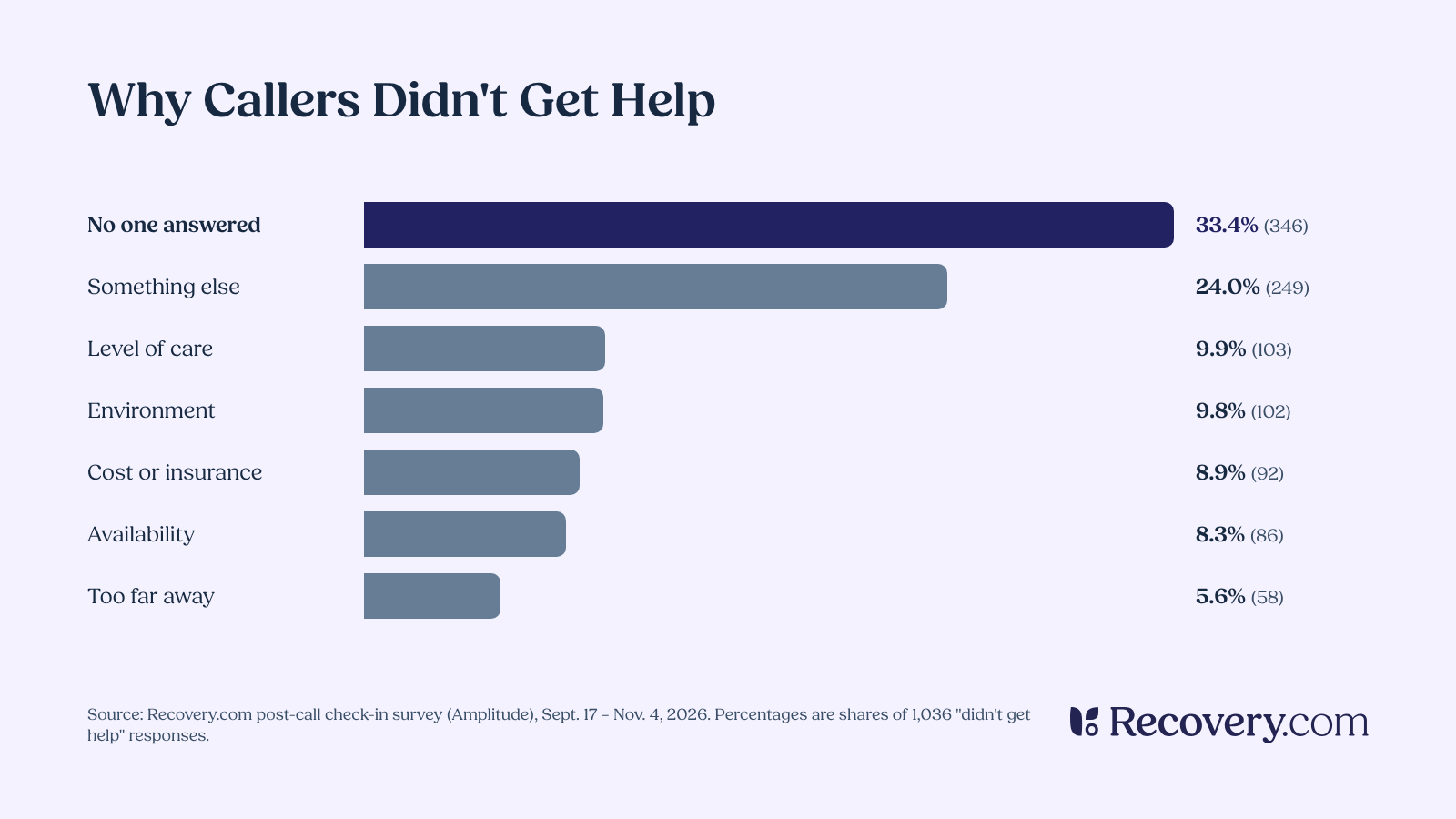
The top reason why people did not get help when they “just asked” was because no one answered the phone.
That data is here, plus insights from team members at Recovery.com and industry professionals who know exactly how this issue affects both patients and providers.
How We Collected This Data
The numbers in this report come from a short survey that appears on Recovery.com after someone calls a treatment center listed on our site. The survey asks whether they got the help they needed. People who answer “no” can choose a reason from a list: the program was too expensive, too far away, not the right fit, no one answered, or ‘something else.’
We collected responses from September 17th, 2026, to November 4th, 2026, for a total of 2,201 responses. Of those, 1,043 said they didn’t get the help they needed, and 346 people (or 33.4%) said it was because no one answered the phone.
The Problem: People Call, No One Answers
In 2025, 47.2 million Americans aged 12 or older needed substance use treatment in the past year, but only 7.6 million (16%) received it, according to the National Survey on Drug Use and Health (NSDUH).1 Our survey data highlights one of many potential barriers to receiving care: calls to treatment providers going unanswered.
Reaching out for help can be a big step for someone, and an unanswered call may create an obstacle between them and treatment. They might try calling again or contact another provider, though our data doesn't tell us what exactly happens next.
It does show that 346 people have experienced this situation in less than two months.
The National Institute on Drug Abuse (NIDA) identifies timely access to care as one of its Principles of Effective Treatment.2 The report continues, “Potential patients can be lost if treatment is not immediately available or readily accessible.” If people call and don’t get an answer, treatment isn’t readily available to them.
Quickly returning calls can catch people before their window closes, and it’s what most providers aim to do. But our survey data doesn’t tell us if people get a call back or eventually access treatment.
We do know that calls going unanswered affects both the people trying to get help and the businesses providing it. Steve Donai, founder of Growth Sherpa Consulting, works closely with treatment providers and sees how unanswered calls make success harder for everyone.
Getting Calls Answered Is a Documented Hurdle for Patients And Providers
Studies show that unanswered calls are an issue in the behavioral health space. In almost no cases is it intentional. Providers dealing with burnout, workplace shortages, challenges with reimbursement, and general time constraints may miss calls unintentionally, as can busy admissions teams.3 It may help patients to know, though, that missed calls aren’t a reflection of their unique inability to get help. They’re a reflection of busy teams, and sometimes disconnected or outdated data.
In one study, researchers posing as patients called 360 psychiatrists across three U.S. cities.4 Only 40% of initial calls were answered. Of the 216 unanswered calls, 36% received a callback. After two rounds of calling, researchers were able to schedule appointments with just 93 psychiatrists (26%).4
Researchers in another study called 322 child psychiatrists.5 They found 19% of the phone numbers were wrong, and observed that, as previous research suggests, calls going unanswered “is more common when patients are trying to obtain mental health care compared with other forms of medical care.”
Our data reflects outcomes similar to these studies, showing that close to half of people who reached out to a provider self-reportedly didn’t get help.
This is a multi-faceted problem, and likely always will be. The behavioral health field is similarly fragmented and often operates without proper funding. The nature of what it aims to heal confounds it all even more.
But we can fix the phone issue.
The Solution
Hire more staff, right?
It's true that hiring extra people may be an option for some providers, but the funds for a full-time, well-trained, around-the-clock admissions team either don’t exist or compete with other priorities.
There are solutions, though, including answering services and having simple plans for handling missed calls.
Help for Answering the Phone
Recovery.com partners with Rollover Rep, a company that uses real people, AI, or both to help treatment centers gain 24/7 coverage of their admissions line. Though patients can’t admit directly through these services, representatives can hear what’s going on, take their information, and let them know when to expect a team member at the center to reach out—and that can make a big difference. Rollover Rep’s founder, Stefan Howlett, has seen it in their own data:

These services can come with their challenges too, mainly in that someone might change their minds before getting a call back to finalize their care. Someone may not like AI answering; someone else may prefer that. But any response beats none and can help someone feel like help is coming.
Many other companies like Rollover Rep exist, too. An initial AI pull found 16 companies that use either AI or humans (or a combination of both) to keep admissions lines covered. The rough average cost of these was $330 a month, with human-only services ranging higher, AI-only lower.
These services can be a big unlock for a small dollar amount, and they can help people get into treatment. Stefan adds this about his experience:
Navigating Missed Calls
Even treatment centers with dedicated admissions teams will miss a call here and there. It’s vital to have a plan in place for when they do.
Keeping track of unanswered calls and then calling them back ASAP is a great plan that many providers follow. Even a basic iPhone will show who called and if it was answered; more sophisticated platforms collect unanswered calls and make it easier for admissions teams to get back to everyone.
It can also help to establish clear expectations for follow-up, including who’s responsible for returning calls outside regular business hours.
Our survey doesn't tell us whether respondents eventually received callbacks or accessed treatment. But overall, improving phone coverage and follow-up processes may help reduce some of the barriers people encounter when reaching out for care.
Takeaways and Implications For Treatment Providers
Our survey highlights an important opportunity for treatment providers to improve access to care. While unanswered calls are only one potential barrier to treatment, providers can take some practical steps to make it easier for people to connect with their admissions teams.
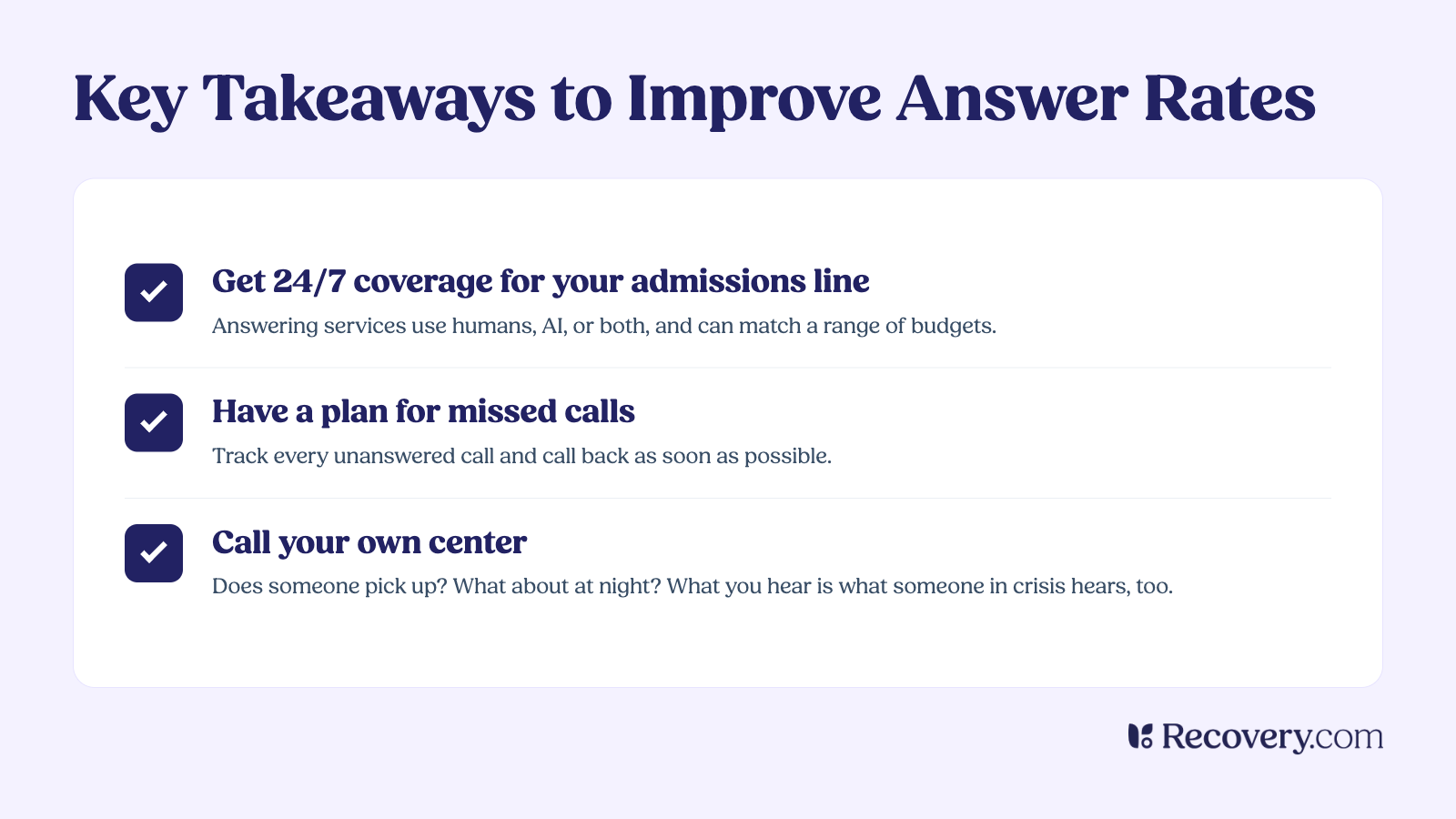
Unanswered Calls Are a Solvable Problem
The behavioral health system has plenty of problems that’ll take work and time to figure out. This isn’t one of them. Answering services, AI coverage, and a simple process for returning missed calls can be affordable solutions, and they’re available right now.
Patients Move on if No One Answers
The window of someone being willing to get help tends to close quickly. When calls go unanswered, people risk not getting into care, and providers lose a patient that may have been a great fit for their program.
Patients may answer a returned call if it’s done promptly. If not, they might find help somewhere else, or, at worst, not receive help.
Answering Calls Can Lower Acquisition Costs
Answering calls can help treatment providers help more people—and spend less doing it. Stefan notes this after 10 years of experience helping providers answer their phones:
Test Your Team
If you run a treatment program, try calling your center. Does someone pick up? What about at night? Whatever you hear, or don’t, is what someone in crisis hears, too.
Interested in learning more about best practices for admissions teams? Check out this article.
In Conclusion: Asking for Help Only Works if Someone Answers
“Just ask for help” can sound simple, but it doesn’t always translate into success. Without a prompt answer, people who’ve finally worked up the courage to call might change their minds about getting help, go to another provider that does pick up, or at worst, give up.
A Senior Performance Manager at Recovery.com adds this:
For their loved ones, an unanswered call can feel like dialing 911 and getting sent to voicemail. It sends the message that no one is coming. And for the person who needs treatment, it can feel like proof that no one cares and that they can’t be helped.
Neither is true. And someone–or something–picking up the phone helps prove that.
Limitations of Our Data
This data shows what happens when people try to reach treatment, but it doesn’t tell the whole story. A few things to keep in mind:
- It only includes Recovery.com users who chose to respond.
- The data covers a short window of time.
- Answers are self-reported and can’t be confirmed.
- Respondents could only pick one reason why they didn’t get help, so two could have been true at once.
- “Something else” was the second most common answer, but the survey doesn’t currently let people explain what they meant. We’re looking at making adjustments to this part of the survey so we can learn more.
- The data doesn’t tell us whether people tried again, found help somewhere else, or stopped looking.
Even with these limits, the pattern lines up with the published research cited above: people trying to get mental health and addiction care often can’t reach anyone.
But we can change that.
FAQs
Many treatment centers have small admissions teams that can’t cover the phone around the clock. Calls that come in at night, on weekends, or during busy periods often go to voicemail. Research shows this happens more often with mental health care than with other kinds of medical care, and our own survey found it was the top reason callers didn’t get help.
As soon as possible, ideally within the same hour. The National Institute on Drug Abuse lists readily available treatment as a core principle of effective care, and notes that people can be lost if treatment isn’t immediately accessible. Someone who calls for help may change their mind or call somewhere else if they wait too long.
According to the 2025 National Survey on Drug Use and Health, 47.2 million Americans needed substance use treatment in the past year, but only 2.6 million received it. There are many reasons for that gap, and unanswered calls are one of the barriers that providers can fix quickly.
An answering service covers a treatment center’s admissions line when staff aren’t available. Depending on the company, calls are handled by trained people, AI agents, or a mix of both. They can’t admit patients directly, but they collect the caller’s information, listen to what’s going on, and let them know when someone from the center will follow up.

Our Promise
How Is Recovery.com Different?
We believe everyone deserves access to accurate, unbiased information about mental health and recovery. That's why we have a comprehensive set of treatment providers and don't charge for inclusion. Any center that meets our criteria can list for free. We do not and have never accepted fees for referring someone to a particular center. Providers who advertise with us must be verified by our Research Team and we clearly mark their status as advertisers.
Our goal is to help you choose the best path for your recovery. That begins with information you can trust.