Find Treatment By
Rehabs by Location


Learn
About Us
Recovery.com combines independent research with expert guidance on addiction and mental health treatment. Our mission is to help everyone find the best path to recovery through the most comprehensive, helpful network of treatment providers worldwide.
Advisory Council
Our advisory council brings together leaders in behavioral health, technology, and business. Their diverse expertise ensures our resources and product are innovative, evidence-based, and effective. They guide our mission as accomplished individuals dedicated to improving the landscape of addiction recovery and mental wellness.
Addiction Treatment Trends 2026: What 33,777 Inquiries Reveal About People Seeking Help



Behind every treatment inquiry is a person looking for an answer.
Between August 2025 and August 2026, people sent 33,777 treatment inquiries through Recovery.com to behavioral health providers. Together, those messages offer a unique window into what people are looking for at the moment they decide to reach out for help.
The numbers are interesting, but we also wanted to know: What can the words people use tell us about what they need?
Key Findings
Across 33,777 non-spam treatment inquiries, several patterns emerged about what people are seeking, what they’re experiencing, and what may stand between them and care:
- Drug treatment was mentioned more often than alcohol treatment.
- Methamphetamine was the most frequently mentioned substance besides alcohol.
- Trauma frequently appeared alongside substance use concerns.
- Depression was the most commonly mentioned mental health concern.
- Medicaid was the insurance people mentioned most often.
- Cost emerged as the most common barrier to treatment among these treatment seekers.
- People reaching out were often already motivated to get help.
Together, these findings offer a closer look at what people may need at a critical point in the treatment journey: when they've recognized a need for help and are trying to turn that realization into care.
Behind the Messages: What People Are Seeking Help For
We found patterns in the types of treatment people were seeking, the substances and mental health concerns they mentioned, and the challenges they faced while trying to access care.
While these findings shouldn't be interpreted as exact prevalence rates, they offer a window into the questions, needs, and barriers that surface when people take the step of asking for help.
Here's what we found.
Find The Perfect Treatment For You
Answer a few questions and we'll match you with the best options.
What Are You Struggling With?
What Kind of Care Do You Need?
What Insurance Do You Have?
More People Inquire About Drug Treatment Than Alcohol, Reflecting a Growing Cultural Shift
We found roughly 10% of inquiries mentioned treatment for alcohol use. Almost 13% were asking about drug addiction treatment. That amounts to over a thousand more people asking about drugs than alcohol.
This graph captures a month-over-month look at drugs vs. alcohol.
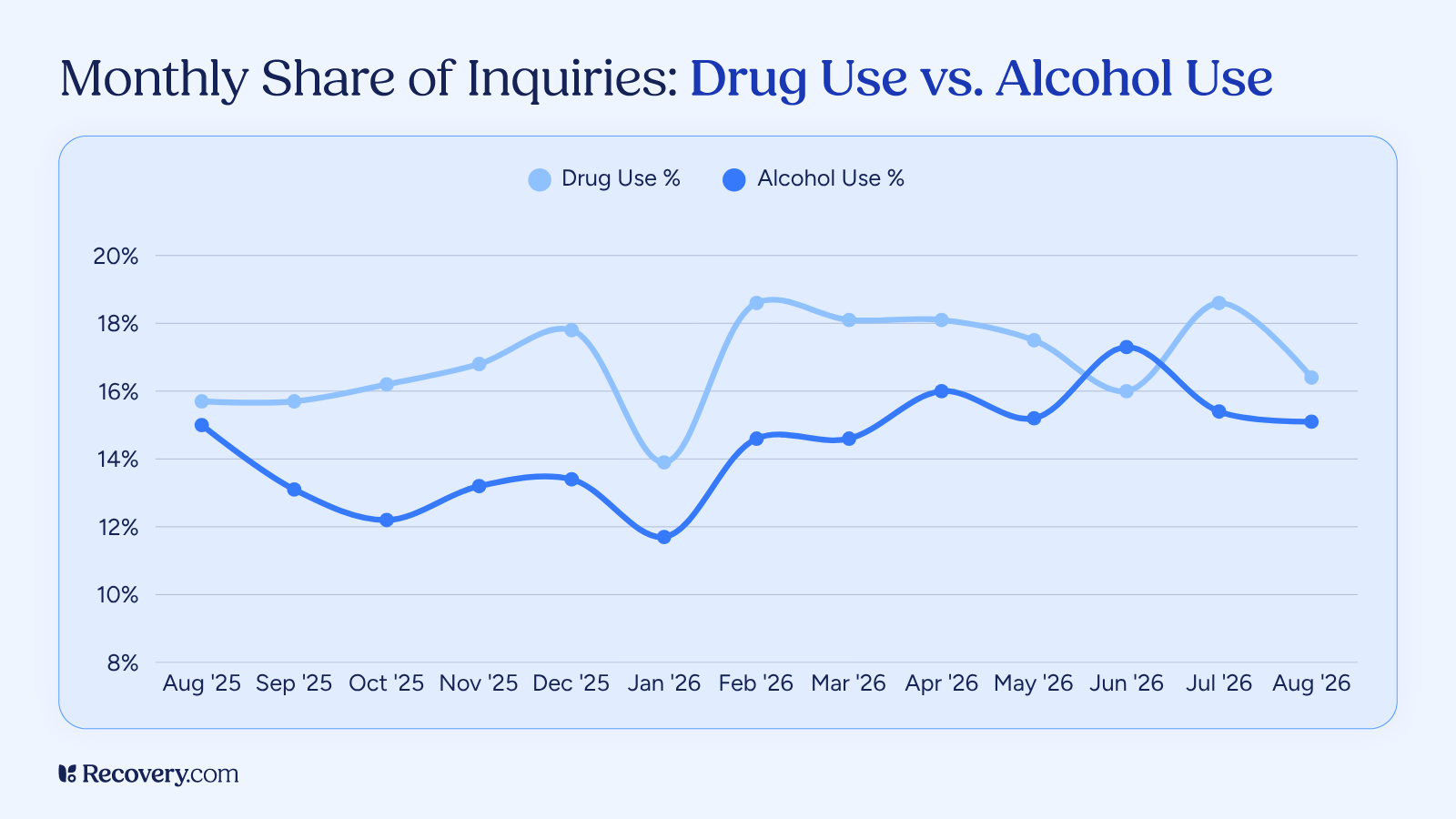
Many inquiries don’t mention drugs or alcohol, but the language points to an addiction of some sort. We found 18% of inquiries used words like ‘detox’ or ‘rehab’ without saying exactly what for.
The Turning Tide
Younger generations have begun a slow turn away from alcohol use, and so have older generations.1 This may be due to the public’s growing understanding of the dangers of alcohol, and the general cultural shift in how drinking, especially excessively, is viewed and rationalized.
As a report by Gallup finds, fewer people are drinking and more people are realizing that alcohol is dangerous.2 A second report finds that fewer young adults drank alcohol in 2025 when compared to the last five years of data, and fewer people reported binge drinking (having 5+ drinks in a row).3
Taken together, these trends provide important context for what we're seeing in Recovery.com inquiries: more people in our dataset specifically asked about treatment for drugs than for alcohol. While our data can't tell us exactly why, the difference comes at a time when Americans' relationship with alcohol appears to be shifting.

Many People Are Aware That Trauma May Cause or Contribute to Their Substance Use
A notable number of people who brought up needing treatment for drugs, alcohol, or both also mentioned needing trauma treatment. A human review of anonymized inquiries notes some people share how a specific traumatic event led to more frequent substance use.
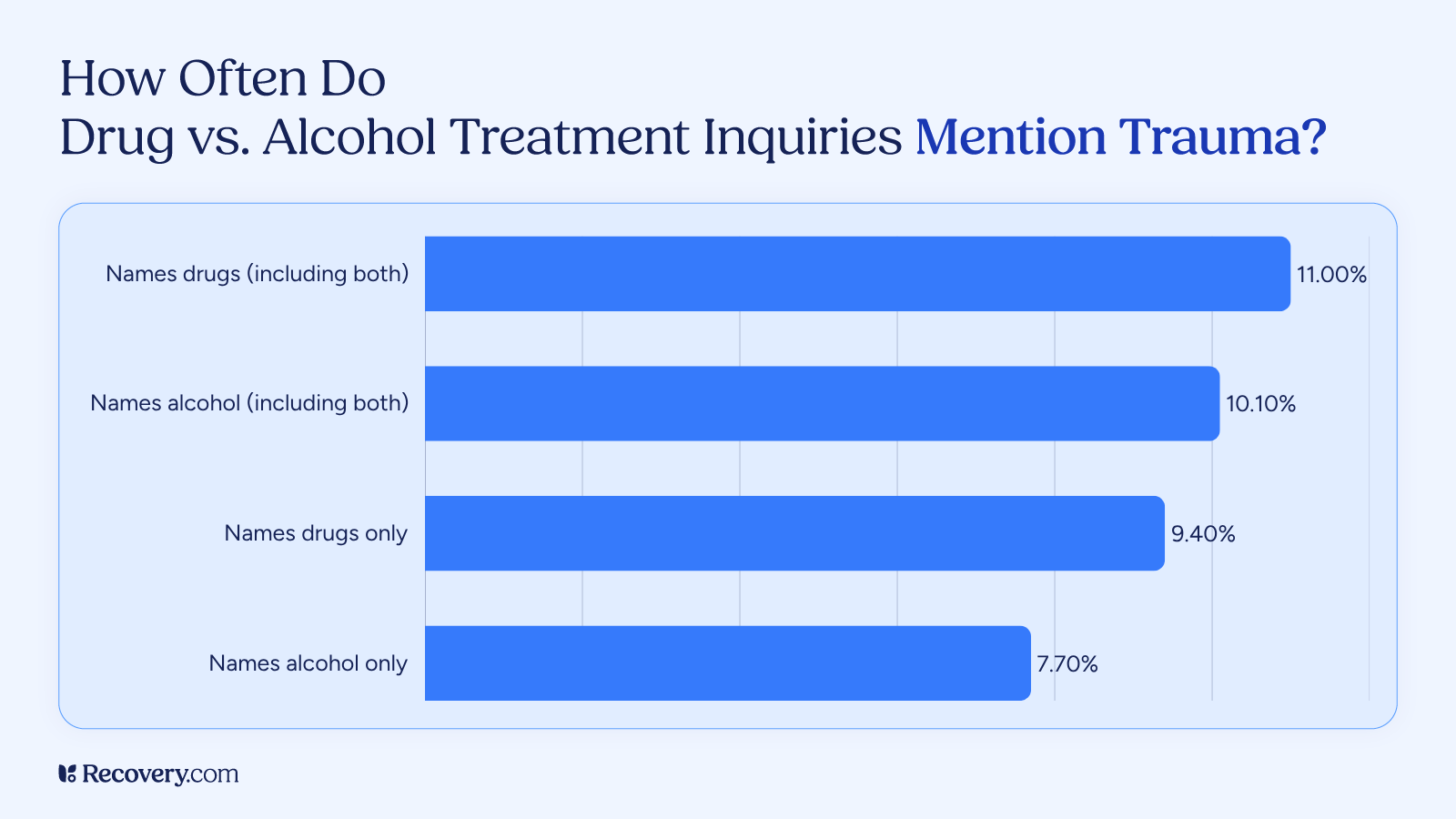
Many people in and out of our cohort have recognized their need for trauma treatment in order to address their substance use disorder, which often serves as a form of self-medication. This supports research showing a strong connection between trauma and resulting substance use, and how they can form a trauma-addiction loop.4 One U.S.-based study supports this with a finding that post-traumatic stress disorder (PTSD) co-occurs with addiction roughly 4 times out of 10, or 45% of the time.5
This is an encouraging level of awareness, and important for treatment providers to know so they can better field inquiries about trauma and addiction. And, so they recognize the clear need for dual-diagnosis care.














People Specifically Mention Meth More Than Any Other Drug
Inquiries surfaced meth use more than any other substance, besides alcohol. We tracked various spellings of it, capturing both ‘methamphetamine’ and ‘meth’ and misspellings, like ‘metamfetimine.’ It ranked far higher than even the next most-mentioned drug, cocaine.
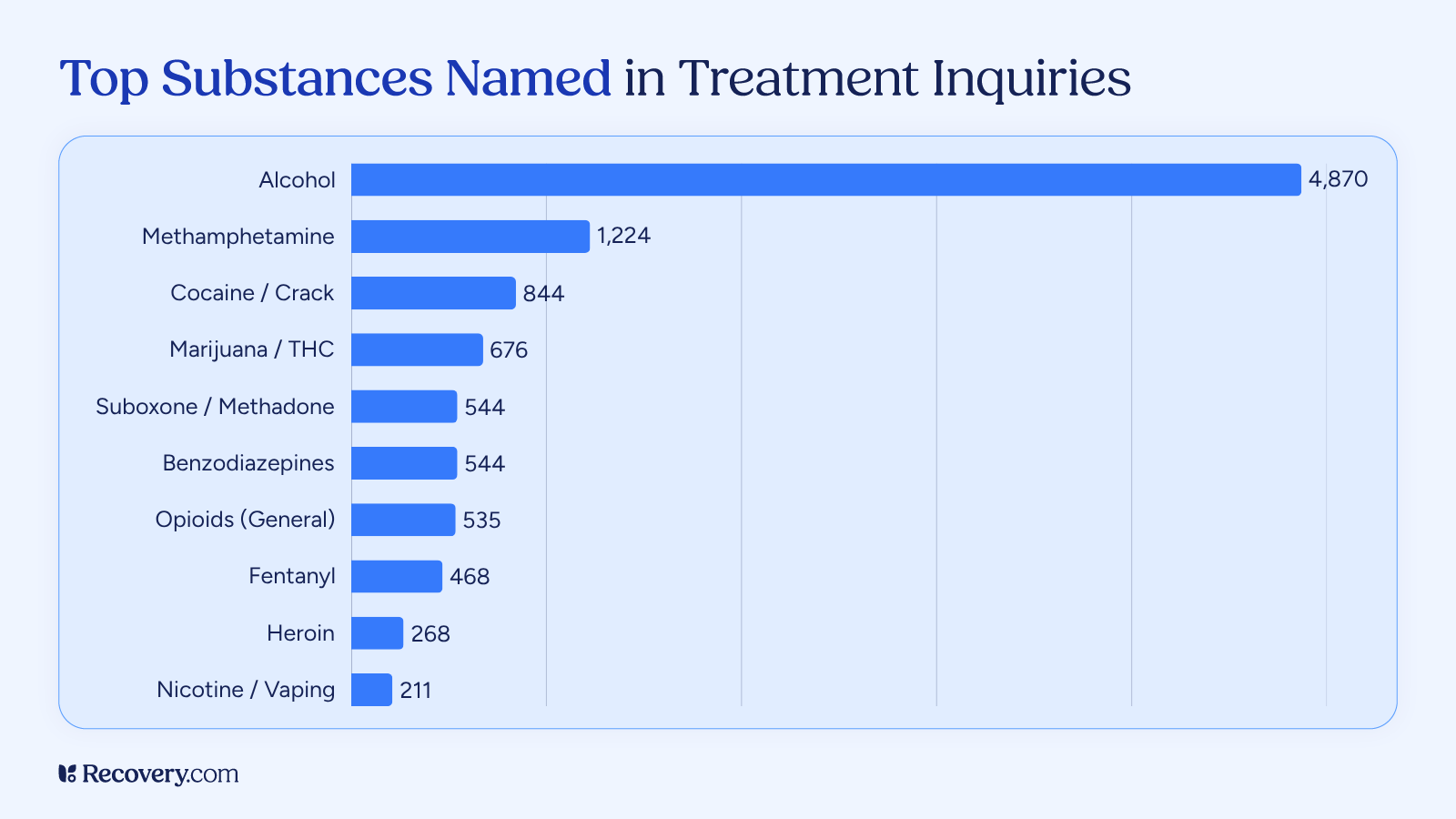
Meth use has been found to be on the rise, according to a report from 2022 and more recent data from 2024.6,7 An even more recent SAMHSA report found meth use to be ‘stable’ from 2021-2025, so neither increasing or decreasing dramatically.8
Requests for meth treatment may be high due to meth use being higher overall and the increasing risk of fentanyl poisoning, especially in powdered forms of meth.9 The looming danger of taking fentanyl by accident, or another similar synthetic opioid, may be prompting more people to want to stop meth use altogether.

People Ask for Help for Depression More Than Any Other Mental Illness
Depression was mentioned around 2,600 times, edging out even broader, but vague, mentions of ‘mental health,’ which came up about 2,500 times.
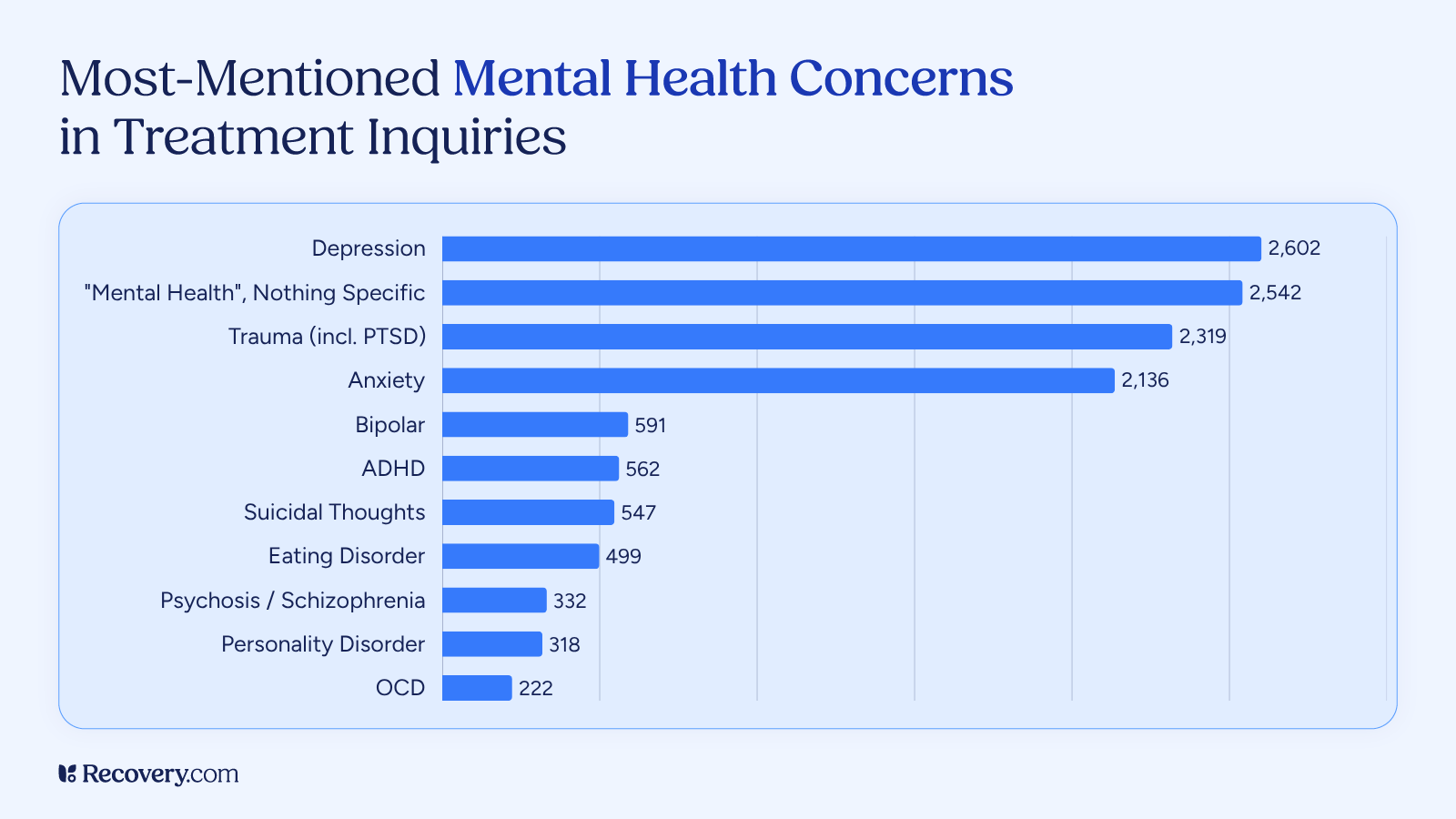
Notably, trauma and PTSD come up third, supporting the trend of trauma co-occurring with, and potentially worsening, substance use disorders or process/behavioral addictions.
Depression may come up most often because it’s both common and comparatively less stigmatized than conditions like bipolar disorder or a personality disorder. People may find it easier to realize they feel down, not like themselves, and recognize their need for help.
And, rates of depression are both high and on the rise. A U.S. report finds that in 2025, 18.3% of people surveyed, which would equate to almost 48 million total Americans, have or are being treated for depression.10 Rates are especially high for younger adults, going from 13% in 2017 to 26.7% in 2025.
Of All Insurances, Medicaid Was Brought Up The Most—Mostly to Ask If It’s Accepted
A lot of people asked if a treatment center accepts Medicaid. More people identified having Medicaid (including state-specific plans) than any other insurance, public or private. Next up was Blue Cross Blue Shield and its variants.
Cost Was The Biggest Barrier to Someone Getting Treatment
People most often said or implied that cost would keep them from getting care if it was too high. Some could pay nothing at all, some requested sponsorships, and others asked if centers could make exceptions.
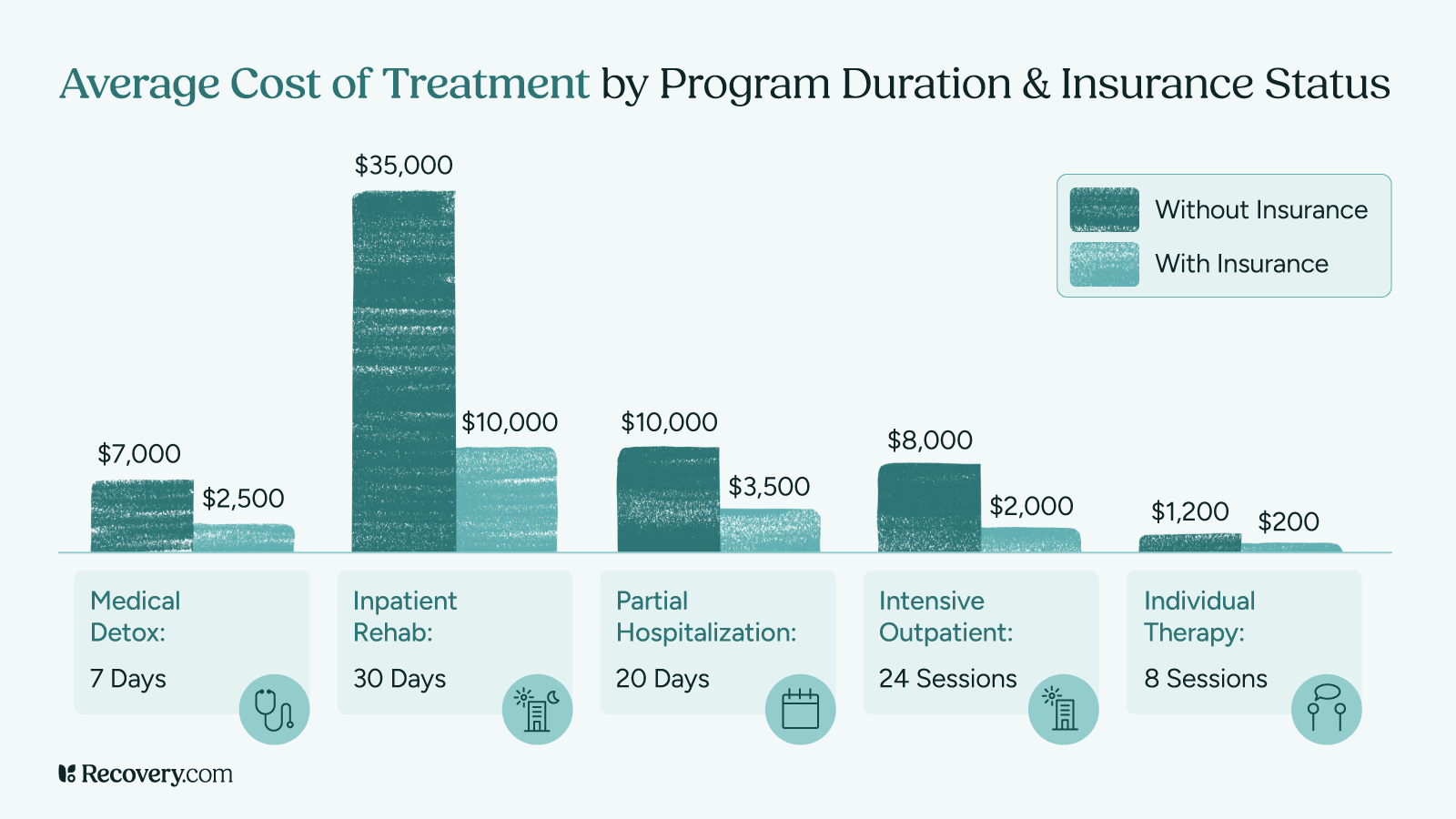
We found cost came up as a barrier in roughly 14% of inquiries. Below that, and similarly, people said their insurance and whether it’s accepted would decide if they get treatment.
Comparing Barriers in This Population to The General Public
Interestingly, in SAMHSA’s 2025 National Survey on Drug Use and Health, their top-reported reason why people do not seek or get treatment is because they don’t believe they need it.11 Beneath that was not feeling ready, and at the bottom of their list, making up 30.4% of responses, was cost and whether insurance would cover treatment.
SAMHSA’s report found lack of perceiving need to be the biggest barrier to treatment. On Recovery.com, with an audience of people who do perceive their need and are actively looking to get into treatment, cost stands in the way most often.
This highlights the difference in barriers between two audiences at different stages of the patient journey.
Recommendations And Next Steps
In summary, we’ve found that for people who perceive their need for care and then try to get it, cost is the barrier they run into most often. For the general public (who were not actively seeking care), their top ‘barrier’ is not believing they need treatment.
More people needed help with drug use than alcohol use. Meth was the top-mentioned drug among drug inquiries. Trauma is an identified cause or occurrence with substance use disorders. People asked most often if Medicaid was accepted, not other insurances.
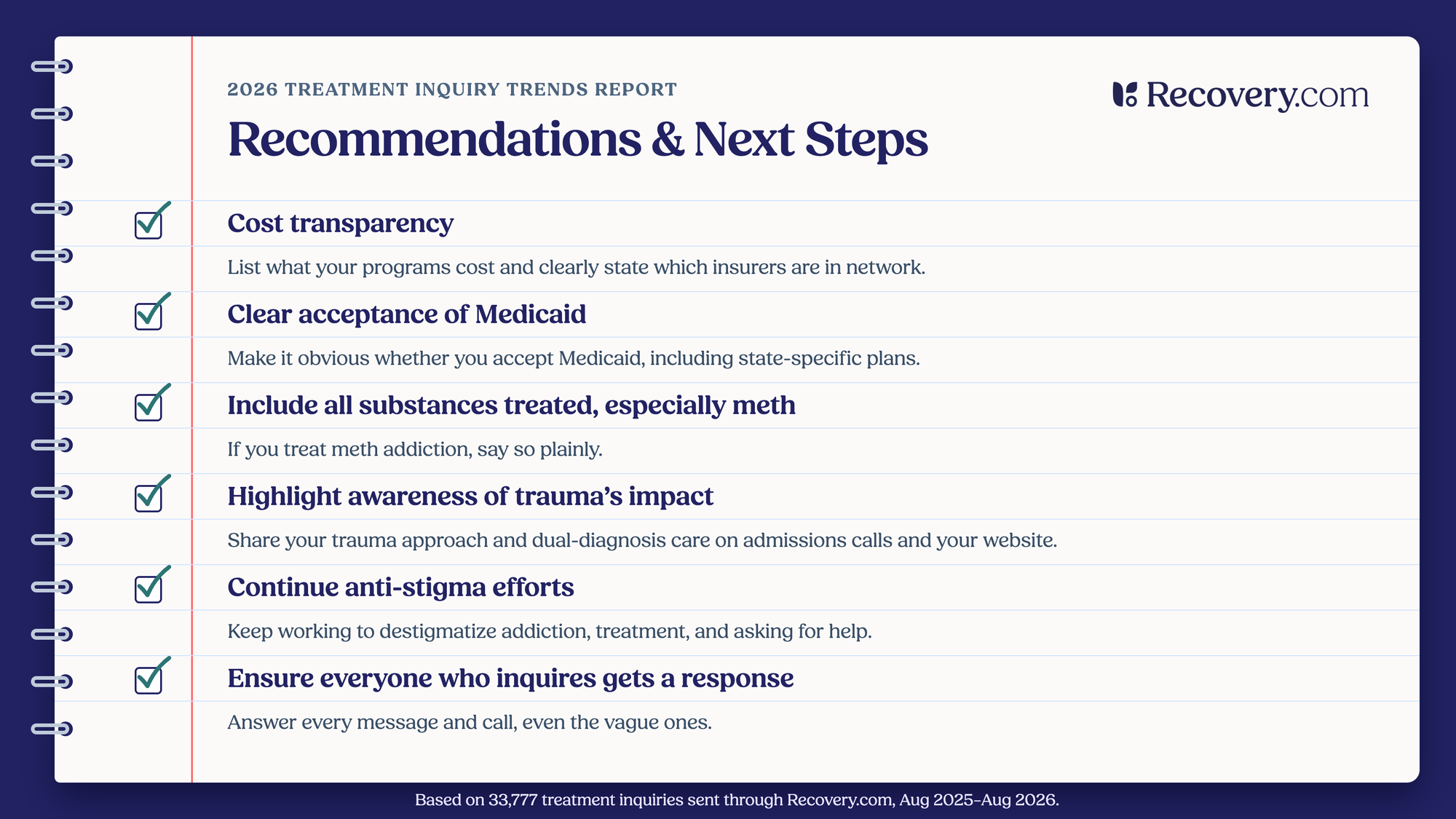
Based on our findings we’d recommend the following.
Cost Transparency
For treatment providers, listing the costs of their programs can be one of the most helpful additions for someone seeking care. Clearly defining which insurance providers are in network, and which are not, adds crucial clarity, too.
Cost transparency is something we value at Recovery.com, which is why center profiles list cash pay rates whenever possible.
Clear Acceptance of Medicaid
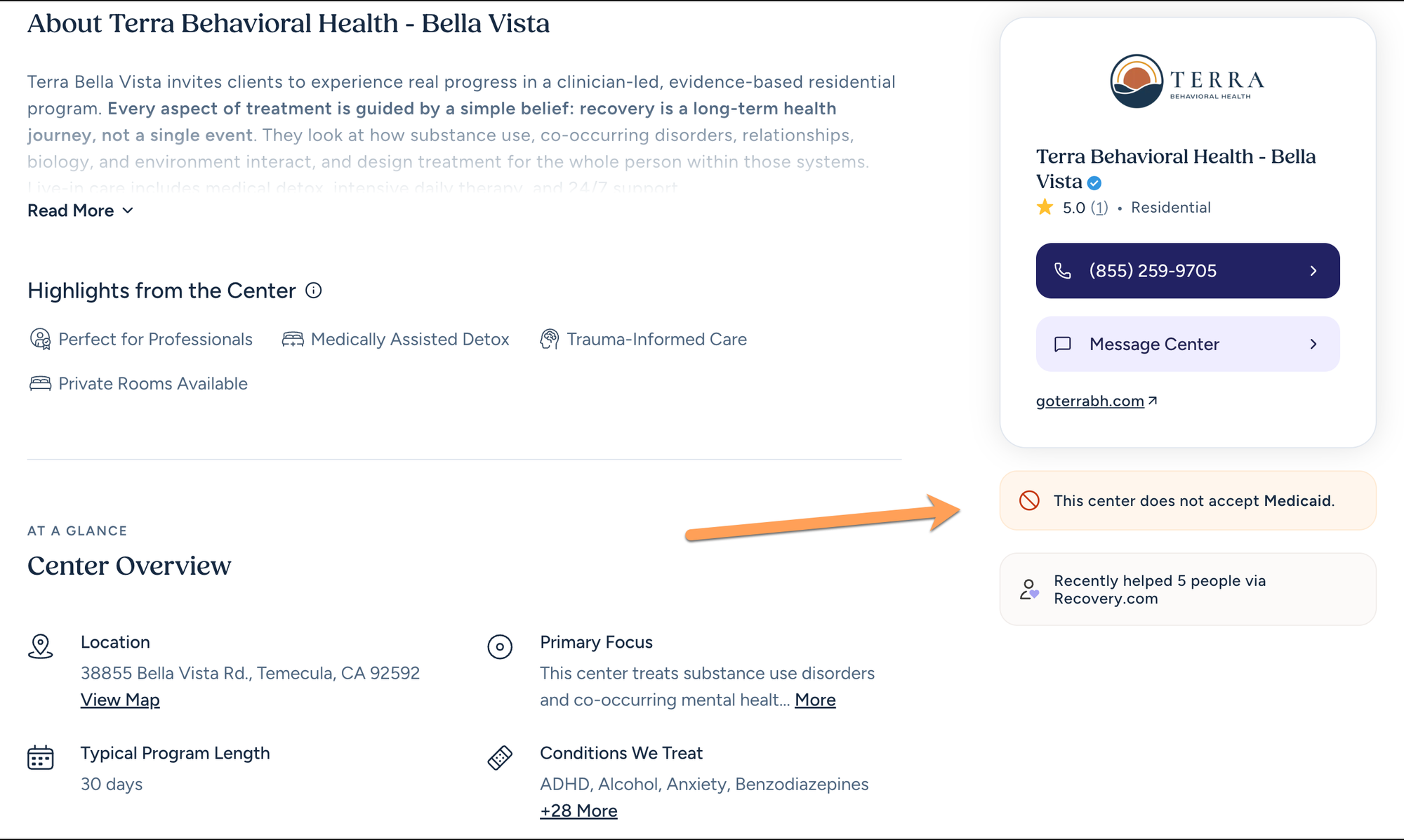
Make this as obvious as possible. At Recovery.com, we indicate when providers do not accept Medicaid on their center profile. People can also filter by their insurance, Medicaid, and only see centers who accept it. We’ve found these changes to be helpful.
Include All Substances Treated, but Especially Meth
If you treat meth addiction, make sure that’s obvious. Recovery.com profiles include this too and can call special attention to meth treatment programs.
Highlight Awareness of Trauma’s Impact on Addiction And Mental Health
We found people held an awareness of their trauma leading or contributing to substance use or mental health conditions, enough to mention in inquiries and ask if trauma is treated, too.
Providers should make both their approach to trauma treatment and their understanding of its co-occurrence clear in admissions’ calls and on their website.
Continue Anti-Stigma Efforts
Many people think they can manage their substance use disorder or mental illness without professional help, and stigma contributes to that belief. This adds to the not-perceiving-need barrier the general public face.
Every business and participant in the behavioral health industry has a duty to continue their efforts in de-stigmatizing treatment, addiction, and asking for help. Prioritizing compassionate, quick responses to any inquiry can prevent a confirmation of internal beliefs about not being ‘sick’ enough, not really needing help, or that ‘no one really cares.’ And to that end…
Ensure Everyone Who Inquires Gets a Response
A small but imperative number of inquiries mentioned needing care now. We can assume many other inquiries are also urgent, even when not explicitly mentioned. All inquiries, even the most vague, deserve an answer.
Someone needs to answer messages and pick up the phone, lest someone’s window of open-mindedness closes, or their condition progresses dangerously.
Conclusion
Behind every one of these 33,777 inquiries is a person who has already done one of the hardest parts of getting help: recognizing they need help and asking for it. For the general public, not perceiving a need for treatment is the most common barrier. The people in this report had already overcome that.
What stood in their way was more tangible and practical. They wanted to know what treatment would cost, whether their insurance (often Medicaid) would cover it, and whether a provider could treat what they were dealing with, whether that was meth use, trauma alongside addiction, or depression. Many of these questions have clear answers that providers can share up front.
That puts a lot within reach for treatment providers. Listing costs, making insurance acceptance obvious, naming the substances and co-occurring conditions you treat, and responding to every inquiry can make the difference between someone getting into care and someone giving up.
People who reach out are ready for an answer. The more clearly and quickly providers and their profiles on Recovery.com can give one, the more of that readiness turns into someone getting treatment.
Limitations
As mentioned previously, numbers in this report are not exact data points, rather signals of trends and commonalities. It’s possible for our AI tool to have misunderstood messages. Exact data counts are not something this report provides.
We’re also limited by the words people chose to omit, or to use. Someone may have misrepresented their need, or not captured it accurately. They may not have mentioned it at all and AI read between the lines.
Our data sample is also limited in the scope of who it includes. Inquiries only come from people using Recovery.com to message a treatment provider, and does not capture trends among people at different stages of the patient journey, or the general public.
Our Promise
How Is Recovery.com Different?
We believe everyone deserves access to accurate, unbiased information about mental health and recovery. That's why we have a comprehensive set of treatment providers and don't charge for inclusion. Any center that meets our criteria can list for free. We do not and have never accepted fees for referring someone to a particular center. Providers who advertise with us must be verified by our Research Team and we clearly mark their status as advertisers.
Our goal is to help you choose the best path for your recovery. That begins with information you can trust.