Find Treatment By
Rehabs by Location


Find Treatment By
Learn
About Us
Recovery.com combines independent research with expert guidance on addiction and mental health treatment. Our mission is to help everyone find the best path to recovery through the most comprehensive, helpful network of treatment providers worldwide.
Advisory Council
Our advisory council brings together leaders in behavioral health, technology, and business. Their diverse expertise ensures our resources and product are innovative, evidence-based, and effective. They guide our mission as accomplished individuals dedicated to improving the landscape of addiction recovery and mental wellness.
Random Acts of Kindness: 15 Ways the Little Heart Project Builds Hope and Prevents Suicide

Terry McGuire is an award-winning journalist and news anchor turned mental health and hope advocate. The Giving Voice to Depression podcast that she created and cohosts has been downloaded more than 2.5 million times, and ranks in the top 1% of global podcasts.
Terry McGuire is an award-winning journalist and news anchor turned mental health and hope advocate. The Giving Voice to Depression podcast that she created and cohosts has been downloaded more than 2.5 million times, and ranks in the top 1% of global podcasts.
Table of Contents
- 1. Depression can begin later in life
- 2. Functioning doesn’t mean you’re okay
- 3. Depression shrinks life and possibility
- 4. Depression trains the brain toward pain
- 5. Small purpose can be protective
- 6. Why the Little Heart Project works
- 7. Tangible reminders can anchor hope
- 8. Messages avoid cheeriness and pressure
- 9. Treatment resistance is real and valid
- 10. Small shifts unlock coping tools
- 11. Coping tools must be accessible
- 12. Healing means shorter, cleaner episodes
- 13. Talking reduces stigma and isolation
- 14. Kindness won’t reach everyone immediately
- 15. Focus on the next doable step
- 16. Key takeaways from Kathleen’s story
- 17. Final thoughts on kindness and staying
This article is a summary of a conversation from the Giving Voice to Depression podcast, hosted by Terry McGuire. In this episode (re-released near Valentine’s Day), Terry and co-host Dr. Anita Sanz speak with Kathleen, a woman whose lived experience with depression, suicidality, and recovery sparked an unexpectedly powerful idea: tiny crocheted hearts, left in public places, designed to make people feel less alone—and to make talking about mental health and suicide feel more possible.
Kathleen’s story doesn’t start with a lifelong awareness of depression. Instead, it begins later in life, after a traumatic family event fractured her world and rewired her mental health. What followed was not a tidy arc, not a quick turnaround, and not a feel-good montage. It was years of getting through each day while carrying depression’s weight, slowly collecting tools she couldn’t fully access yet, and eventually finding a treatment that shifted something inside her mind.
Out of that hard-earned shift came the Little Heart Project—an act of kindness that’s also a conversation starter, a community-builder, and, in many cases, a small lifeline. Below is a structured breakdown of what the episode reveals about depression, stigma, treatment resistance, and the practical ways simple human connection can help keep people here.
1. Depression can begin later in life
Many guests on the podcast describe symptoms they can trace back decades. Kathleen’s experience is different. She had never lived with depression until a traumatic family event near age 50 changed everything.
The episode intentionally avoids personal details. What matters is the impact—the way trauma can rewire a nervous system even when the external chapter appears “closed.”
As Kathleen explained it plainly:
And eventually after a month, the charges were dismissed, which means in the courts it's as if it never happened, but it did happen, and it left me with depression, anxiety, complex PTSD and suicidality.
That line captures something many people recognize: events may end, but their emotional consequences often do not.
2. Functioning doesn’t mean you’re okay
Kathleen did not disappear from life. She kept going—working, showing up, surviving—while quietly unraveling.
As Kathleen described her daily reality:
There was a lot of nothing. … I continue going to work, cried a million tears in the bathroom, and then you wipe your face off and go back to work.
Depression often hides behind productivity. It can look like reliability, responsibility, and endurance—while internally, someone is barely hanging on.
3. Depression shrinks life and possibility
Early depression didn’t just make Kathleen sad. It made the future feel unreachable.
As Kathleen remembered:
In the beginning it was just me lying on the sofa, just crying a lot, just hopeless, like no future.
That inability to imagine a future is one of depression’s most dangerous symptoms. When tomorrow feels inaccessible, staying alive today becomes much harder.
4. Depression trains the brain toward pain
Kathleen speaks candidly about how depression sharpened her focus on cruelty and disappointment.
As Kathleen put it bluntly:
Stop being surprised. People suck.
Depression narrows attention toward evidence that supports hopelessness. Healing, for Kathleen, began with learning to turn just a little toward something good—not to deny reality, but to balance it.
5. Small purpose can be protective
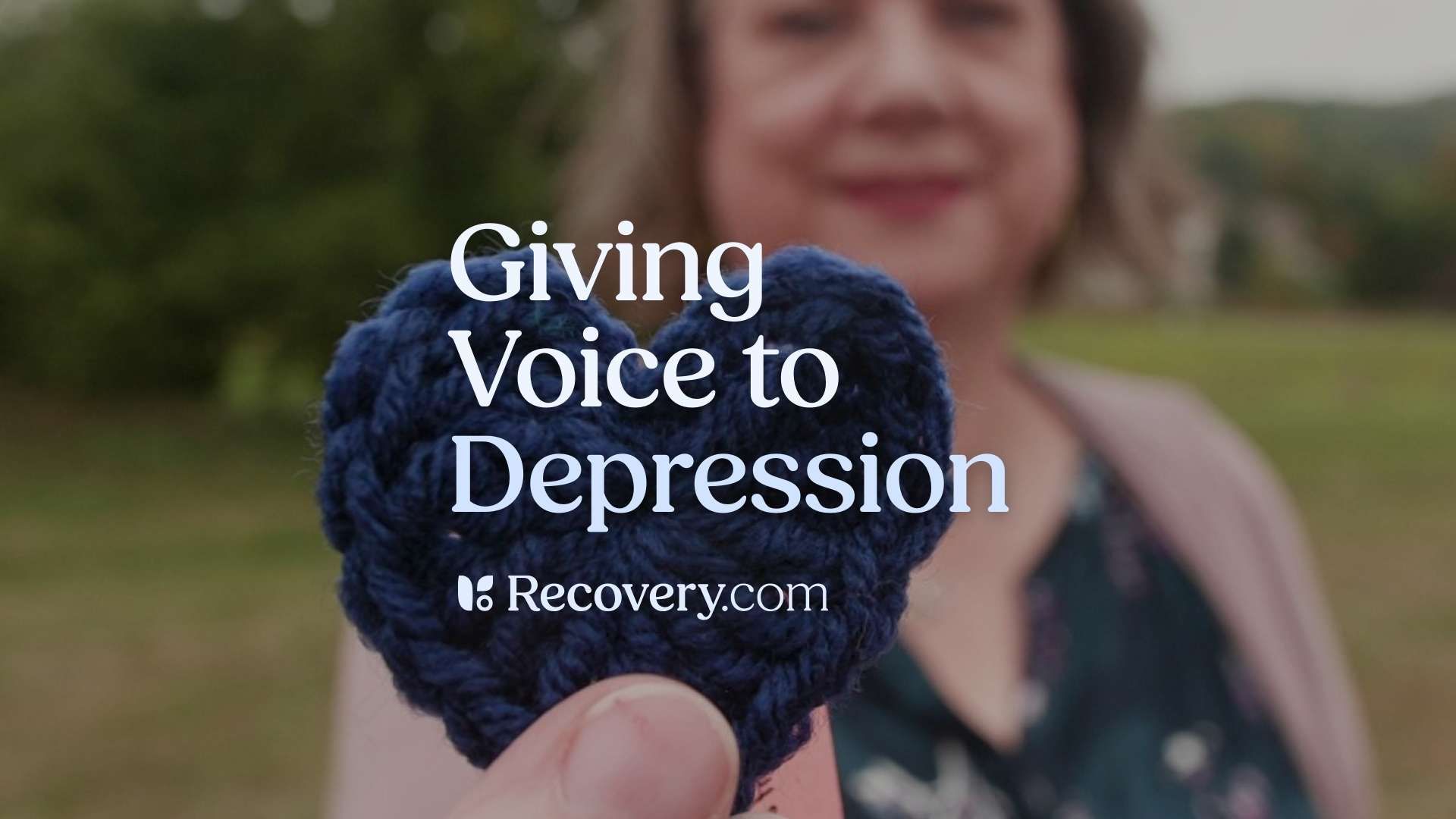
A therapist introduced Kathleen to a crocheted yarn heart—not as motivation, but as an invitation.
As Kathleen clarified:
She didn't show it to me to say like, "Hey, get off your butt and do something." She was saying, just showing because she knew I crocheted.
That gentleness mattered. Purpose didn’t arrive as a calling—it arrived as a small, doable activity.
As Kathleen shared:
It was enjoyable. It's just mindful, it's just enjoyable to do for me.
6. Why the Little Heart Project works
Kathleen eventually realized the project touched more than the person who found the heart.
As Kathleen explained:
The people that make the hearts are touched, the people who place the hearts are touched, and the people who find the hearts are touched.
The project creates connection at every step, quietly reducing isolation and stigma.
7. Tangible reminders can anchor hope
The hearts endure because they’re physical.
As Kathleen shared:
I hung mine on the mirror in my car.
And in another story that stayed with her:
As Kathleen recalled:
I have it in my bedroom and I read it every day and it helps me every day.
For someone struggling, a tangible reminder can do what internal reassurance cannot.
8. Messages avoid cheeriness and pressure
Kathleen avoided platitudes.
As Kathleen said directly:
None of 'em say that because that is not helpful.
Instead, the messages focus on compassion and permission.
As Kathleen explained:
What would it sound like to extend compassion to yourself?
And:
It's okay to not be okay.
These messages don’t minimize pain—they acknowledge it.
9. Treatment resistance is real and valid
Kathleen spent years trying therapy and medication without relief.
As Kathleen explained:
Nothing is working, nothing's helping. And so that's where I was: treatment-resistant.
She also named a reality many face:
As Kathleen said openly:
It's very expensive and it's not covered by insurance.
Her story validates the frustration of “doing everything right” and still struggling.
10. Small shifts unlock coping tools
After ketamine therapy, something changed—not immediately, but meaningfully.
As Kathleen realized:
I'm not thinking about killing myself all day long.
She had a toolbox all along.
As Kathleen explained:
I had a full toolbox from nine years of therapy but for many years I didn't have access to it.
That distinction matters: tools can exist even when depression blocks access.
11. Coping tools must be accessible
Kathleen described simple, realistic coping strategies.
As Kathleen shared:
I am learning to listen to my body more.
Her approach includes asking:
- Do I need to move?
- Do I need rest?
- Do I need distraction?
- Do I need connection?
These questions create options when thinking feels rigid.
12. Healing means shorter, cleaner episodes
Kathleen doesn’t claim depression is gone.
As Kathleen described:
They're much shorter in length, and I come out of them more cleanly.
Progress looks like quicker recognition and faster recovery—not perfection.
13. Talking reduces stigma and isolation
Sharing her story created safety for others.
As Kathleen explained:
That's how healing happens is we talk about it.
And:
People want to share their story with me because they see me as someone safe.
Conversation doesn’t cause suicidality—it reduces its power.
14. Kindness won’t reach everyone immediately
Terry asks whether a heart would have helped Kathleen during her darkest years.
As Kathleen said frankly:
For me, it would not have.
She also explains why hope can hurt.
As Kathleen explained:
Hope is disappointing.
That honesty protects people from shame when encouragement doesn’t land.
15. Focus on the next doable step
The episode closes with a grounding principle.
As Dr. Anita Sanz explained:
I just need to do the next thing I have control over.
As Terry summarized it simply:
the next best thing.
Small steps matter—especially when the path feels overwhelming.
16. Key takeaways from Kathleen’s story
Kathleen’s journey and the Little Heart Project offer lessons that extend far beyond yarn hearts.
First, depression does not require a lifelong history. Trauma at any stage of life can fundamentally alter mental health. No one is “immune.”
Second, survival still counts, even when progress feels invisible. Years of therapy were not wasted—they quietly built a toolkit that became accessible once something shifted.
As Dr. Anita Sanz emphasized:
You are learning and hearing and gathering these tools the whole time. You may not be able to use them yet, but you've got your toolkit.
Third, small, human-scale actions can reduce stigma more effectively than grand campaigns. The hearts work because they make conversations possible.
Finally, hope does not need to feel inspiring to be real. Sometimes it exists as 0.01%. Sometimes it’s held by someone else. Sometimes it’s simply staying.
17. Final thoughts on kindness and staying
This episode doesn’t end with certainty. It ends with steadiness.
Kathleen does not promise that kindness saves everyone. She does not claim depression is cured. She simply asks a different question: What can I do?
As Kathleen reflected:
It feels so much better to figure out what can I do instead of "I can't, I can't, I can't." What can you do? And everybody can do something.
Terry reinforces that perspective throughout the podcast.
As Terry reminded listeners:
Anything safe and positive can open a door if and when the person on the other side is in a place where they can walk through it.
The Little Heart Project doesn’t force anyone through that door.
It just makes sure the door exists.
And sometimes, that is enough.
Our Promise
How Is Recovery.com Different?
We believe everyone deserves access to accurate, unbiased information about mental health and recovery. That's why we have a comprehensive set of treatment providers and don't charge for inclusion. Any center that meets our criteria can list for free. We do not and have never accepted fees for referring someone to a particular center. Providers who advertise with us must be verified by our Research Team and we clearly mark their status as advertisers.
Our goal is to help you choose the best path for your recovery. That begins with information you can trust.