Find Treatment By
Rehabs by Location


Learn
About Us
Recovery.com combines independent research with expert guidance on addiction and mental health treatment. Our mission is to help everyone find the best path to recovery through the most comprehensive, helpful network of treatment providers worldwide.
Advisory Council
Our advisory council brings together leaders in behavioral health, technology, and business. Their diverse expertise ensures our resources and product are innovative, evidence-based, and effective. They guide our mission as accomplished individuals dedicated to improving the landscape of addiction recovery and mental wellness.
Reverse Content Marketing: 6 Steps to Grow Your Treatment Center Census



If you work at a treatment center and you are trying to grow your census, here is something most marketing agencies will never admit: the content you are probably spending the most time on, blogs and social media, is often the lowest converting content you can make.
Disappointing, I know. So what actually works?
I want to walk you through something I call reverse content marketing. It is a six-step framework built from the end of the funnel backwards. Most people build content starting with what is easiest. We are going to start with what actually drives census.
Stick with me to the end, because I will also show you how to save thousands of dollars on one of the most powerful content assets you can create.
I am Clint Mally. I have worked at a treatment center and helped grow it to more than 20 locations across four states with a full continuum of care. I have run this playbook over and over, and I know it works.
Let's get into it.
Step 1: Create Your Call Flow Script

Before you spend a single dollar on marketing, there is one thing you absolutely have to do first, and almost no one does it. Skip this step and every lead you generate leaks right out of the bottom of your funnel.
Start by asking people on your team a simple question: "How would you describe our treatment center in one sentence?" If you get five different answers, you have a problem. When someone calls after seeing your content or your ad, they need to hear the same message they just read or watched. Consistency builds trust. Inconsistency loses admissions.
A solid call flow script has three parts.
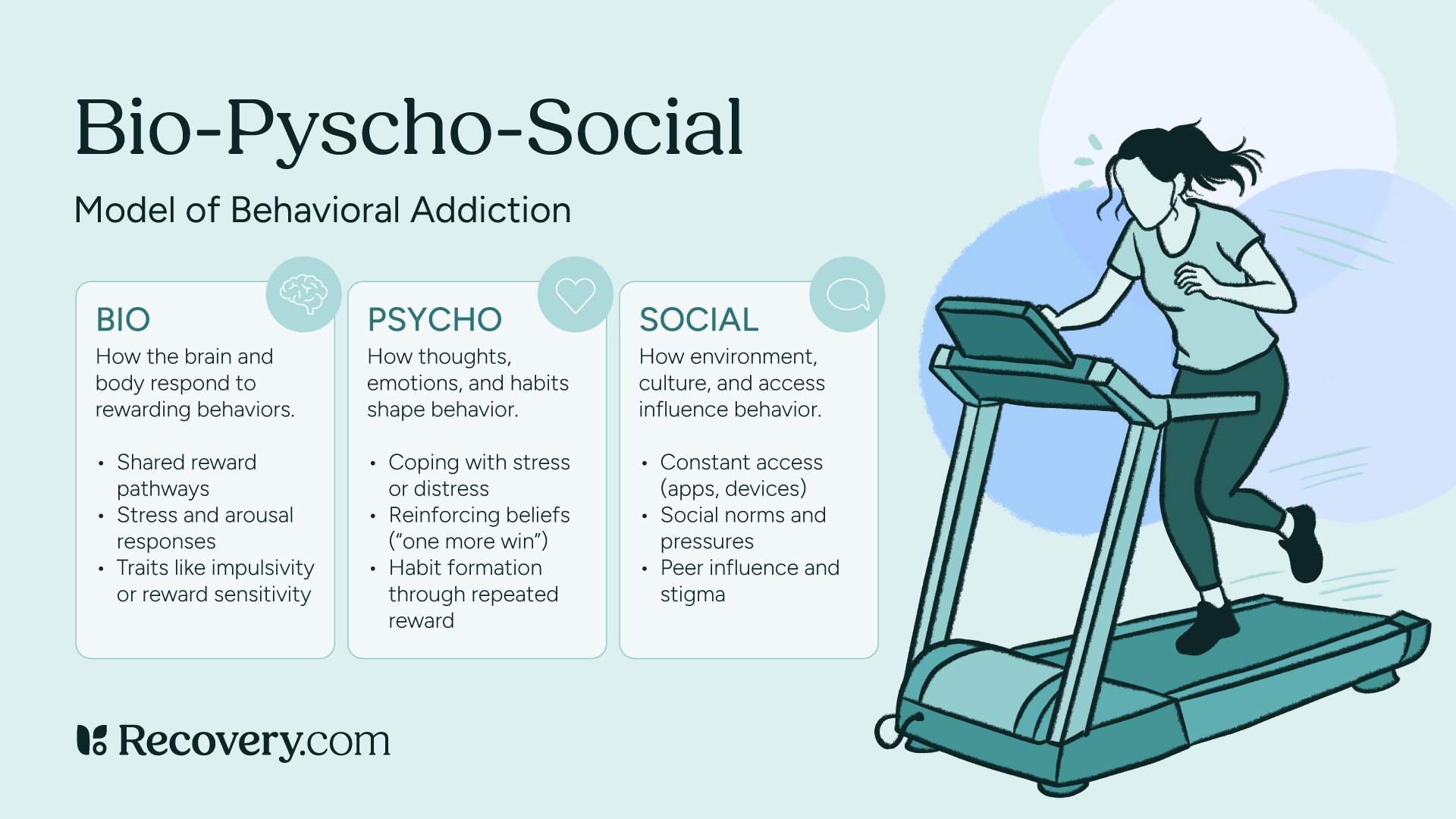
1. Your top three reasons your treatment center works. Be specific. For example, biopsychosocial care. A lot of treatment options only address one or two of those dimensions, but if your center addresses all three, that is a differentiator. Name it.
2. Three clear steps to work with you. Something like:
- Step one: Call us and speak to an admissions coordinator.
- Step two: Verify your insurance or set up a financial plan.
- Step three: Complete a clinical assessment and start treatment.
Simple, repeatable, and easy to say on a call.
3. A one-sentence description of your center. Here is the formula: who you help, plus how you help them, plus the benefit you bring. For example: "Recovery Treatment Center helps teens, young adults, and their families overcome mental health and substance use challenges and regain control of their lives." Every person on your team should be able to say that without thinking.
Here is the bonus. Once you have the script, you can build a rubric from it. You can coach your admissions team against that rubric, identify exactly where someone is losing the caller, and end the endless debate over whether marketing is sending bad leads. Now you have a standard way to know what a good call actually looks like.
Most centers only build this after they realize they have a conversion problem. Do not be that center. Build it first.
Step 2: Set Up Conversion Measurement Before You Spend Anything
Here is a mistake I see constantly: treatment centers spending money on marketing before they have any idea what is actually working. Before you run a single ad or publish a single page, get this infrastructure right.
Dynamic phone number tracking
Use a tool like CallTrackingMetrics to swap numbers based on traffic source. This tells you exactly which channel drove each call, whether it was Google, your website, a referral, or a specific ad. Without it, you are flying blind.
A VOB form built correctly
This is where most centers either over-engineer the form or leave out critical information. Here is what your verification of benefits form actually needs, and only what it needs.
Insurance information required to run the VOB:
- Insurance carrier, ideally a dropdown of your in-network carriers with an "other" option
- Member ID number
- Policy holder date of birth (this is the one most centers forget, and it is required by insurance companies to pull benefits)
Contact information required to reach the individual or family:
- First and last name
- Address
The form is only half of it. Set up a thank-you page as a conversion event in GA4. When someone submits the form and lands on that page, that is a lead, so fire a conversion and track it. This lets you tie form submissions to real revenue over time and see which sources actually produce qualified admits.
And here is something most people miss: your thank-you page is prime real estate. Do not just say "Thanks, we'll be in touch." Tell them "We'll be calling you within five minutes," and then actually call within five minutes. Response time is one of the biggest predictors of whether a lead converts. Someone who submits your VOB form is usually filling out three other forms at the same time, and the first center to call wins. While they wait, show them what comes next: a short video from your admissions team explaining the process, alumni testimonials, anything that builds trust and gives them a reason to wait for your call instead of moving on.
Lead scoring on every admissions call
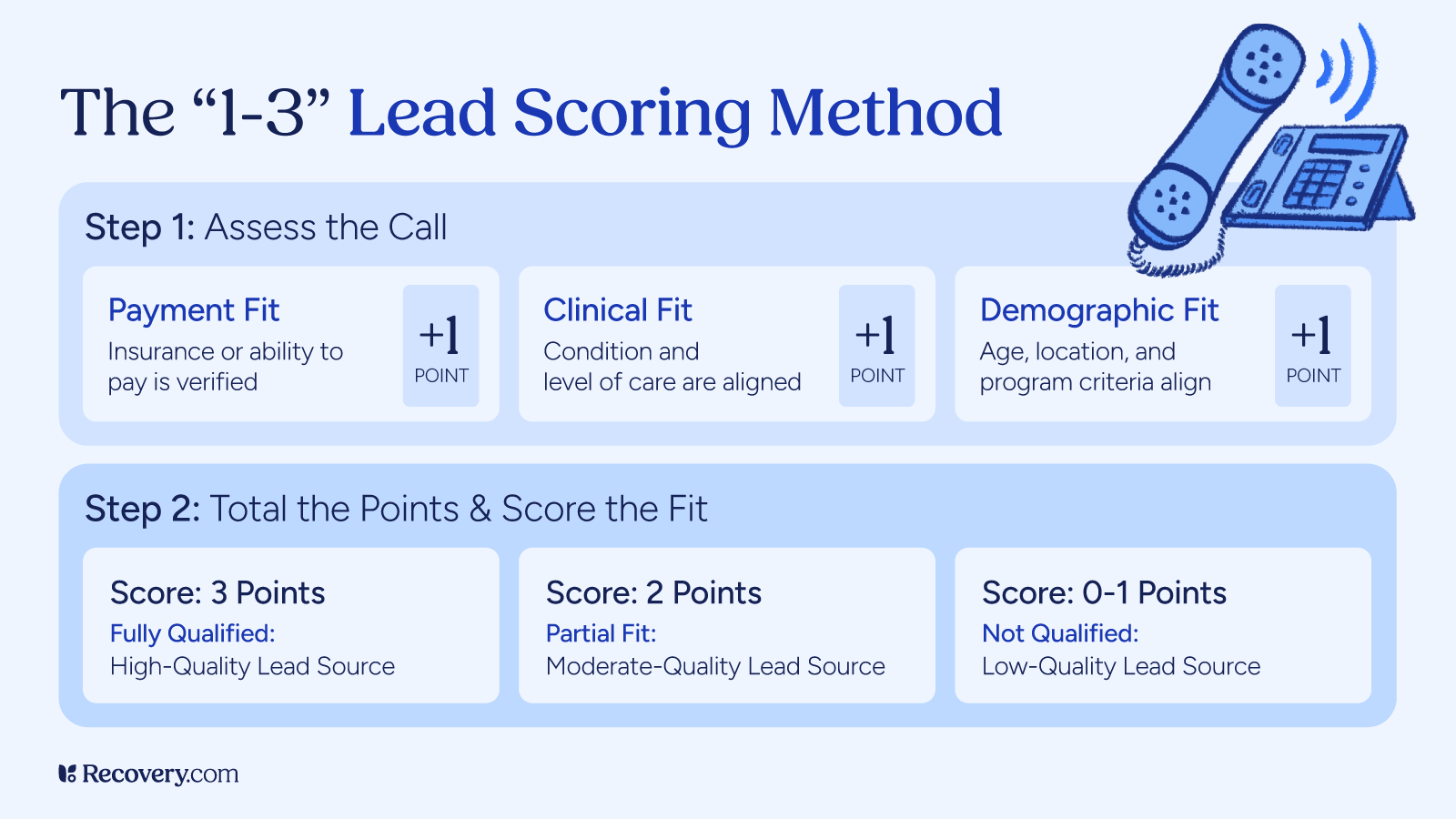
Every inbound call and form submission should be scored. A score of three, your highest priority, means the caller meets all three criteria:
- Payment eligibility: They are in-network with your insurance or have confirmed private pay.
- Clinical fit: The condition is something you can treat at an appropriate level of care.
- Demographic fit: Age, location, gender, and population requirements all line up.
Track your answer rate and build in rollover coverage. Calls that go unanswered during business hours are one of the most expensive problems in treatment center admissions, and most centers do not even measure it.
If you are not scoring leads and tracking response time, you cannot have a serious conversation about whether your leads are good or your process is the problem.
Step 3: Build Trustworthy Location Pages and Google Business Profiles
If someone finds your treatment center online and lands on your location page, you have about five seconds to convince them you are the right place. Most location pages fail that test. Here is the framework that makes them work.
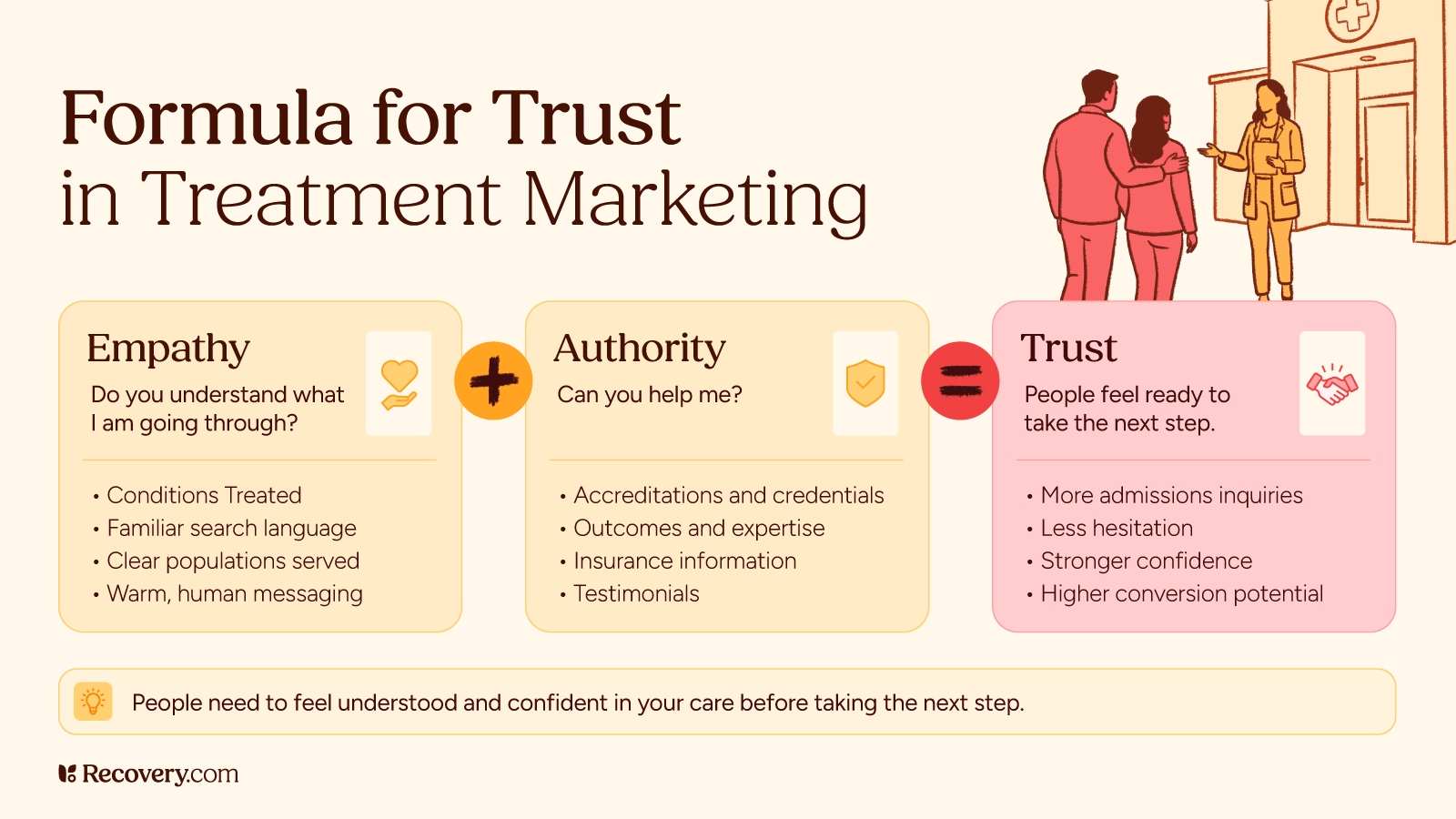
Trust comes from a simple equation: empathy plus authority equals trust.
Empathy means the person feels understood. Does your page speak directly to what they are going through? Do you clearly list your levels of care, the people you help, specific conditions, acuity levels, and demographics? And critically, do you know how people actually search for what you offer? There is a big difference between "adolescent residential treatment" and "teen rehab." One is clinical language. The other is a scared parent typing at midnight. You need to know the difference.
Authority means the person believes you can actually help. This shows up through clearly listing where you are located, your insurance and payment information, photos of your center, and your areas of expertise.
Beyond empathy and authority, every location page should address what the ancient Greeks called pathos, ethos, and logos.
Pathos is emotional persuasion: video testimonials, Google reviews, and real stories from real people. (More on testimonials at the end of this post.)
Ethos is credibility: accreditation logos like Joint Commission, CARF, LegitScript, or Recovery.com, displayed clearly. Show your clinical team's photos and credentials, along with the logos of insurances you are in-network with. One tip here: many centers mute the colors of these logos. Do not. Color conveys credibility, and it is one of the cues people use when scanning for their specific insurance. Keep the color.
Logos is data and proof: outcomes, statistics, and graphs. The gold standard is something like your PHQ-9 or GAD-7 outcome data visualized in a chart. If you do not have that, use what you have: combined years of staff experience, number of therapeutic modalities, how long you have served the community. Find a way to quantify your effectiveness.
One last note. Your Google Business Profiles matter too. Keep them updated, respond to reviews, actively generate and request reviews, and make sure your name, address, and phone number (NAP) are consistent everywhere they appear online.
Step 4: Create Local Service Pages for Every Program and Population You Serve
Here is what most treatment centers get wrong about SEO. They build one page and wonder why it is not ranking for everything. There is no single page that rules them all. Specific pages rank for specific searches, and every program and population you serve deserves its own page.
Think about it this way. Someone in Atlanta searching for trauma treatment is not the same as someone in Atlanta looking for addiction support. Those are different searches, different intents, and different people, and they deserve different landing pages that speak directly to them.
So create dedicated pages for your service lines and populations:
- Atlanta trauma treatment
- Nashville IOP
- Los Angeles veterans addiction treatment
- San Diego women's only detox
Apply the exact same trust framework from Step 3 to every one of these pages: empathy plus authority, and pathos plus ethos plus logos, all of it. Keep the structure the same. What changes is the specificity of the program or population.
One important caveat: only create these pages for programs and populations you genuinely specialize in. A page that claims to treat everything for everyone does not rank, and it does not convert. Real specialization wins in both search results and in the minds of the people reading.
Step 5: Create "Obstacle Overcome" Content Around Every Question Your Team Hears
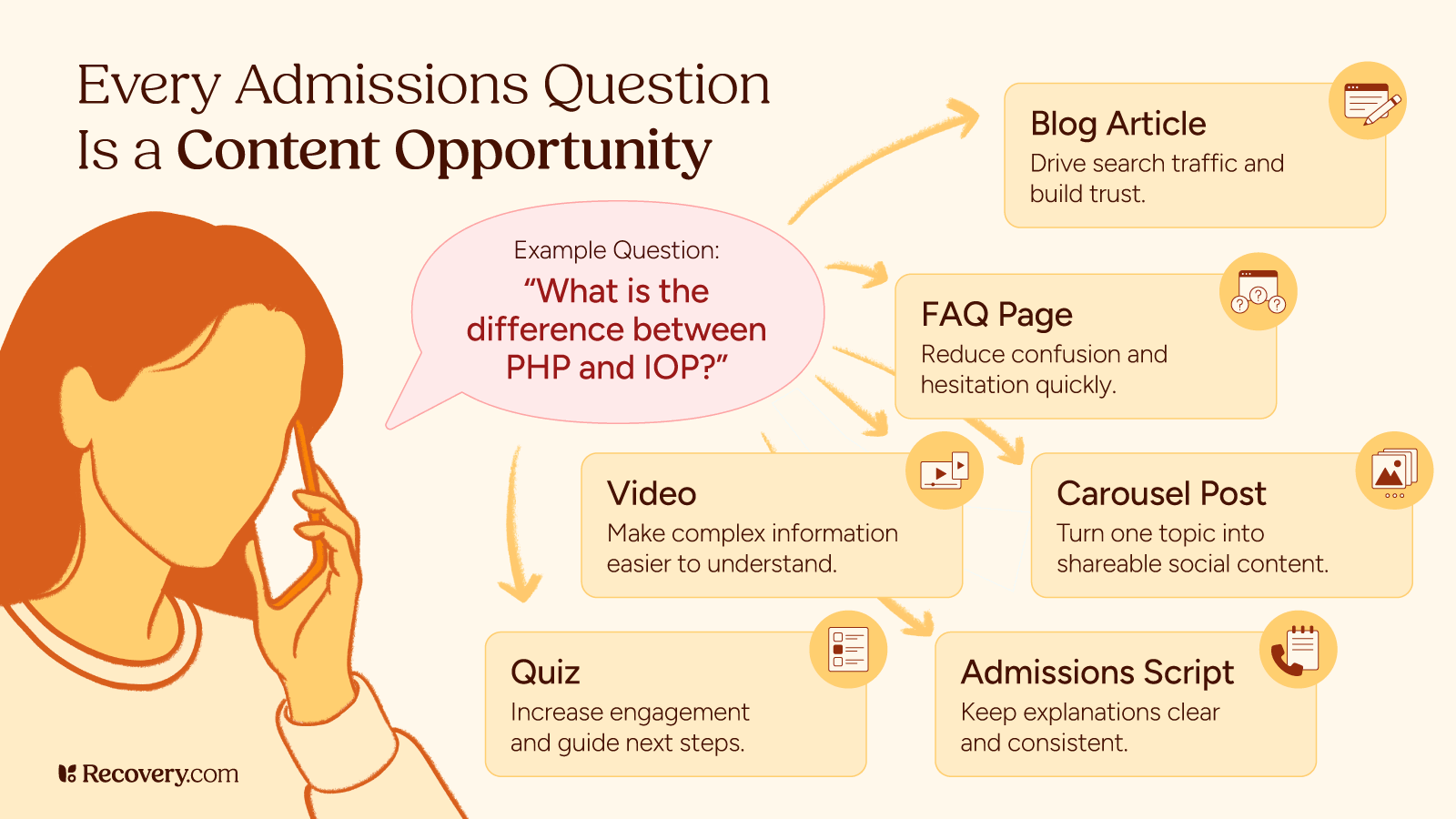
This is one of the highest-leverage things you can do in content marketing, and it requires zero guesswork. If anyone on your admissions or business development team has been asked the same question more than once, that question is content. Period.
- What is the difference between IOP and PHP?
- How do you help a loved one who is not sure they are ready for treatment?
- What can I do to support them while they are in treatment?
- Is my kid addicted, or are they just experimenting?
These are real questions from real people in crisis. They type them into Google at 3:00 a.m. They ask admissions coordinators. They text a BD rep. If you have content that answers these questions clearly, you become the trusted source before they ever make the call.
This is exactly why admissions, business development, and marketing need to be in constant communication. Your marketing team should regularly listen to calls, not to audit anyone, but to hear the actual voice of your customer. What words do they use? What fears come up again and again? What objections keep showing up? Content built from real conversations converts. Content built from what marketers think people want to know does not.
For format, these can be videos, blog posts, graphics, quizzes, or, if you want to go all in, all of the above.
Step 6: Now You Are Ready for Social Media
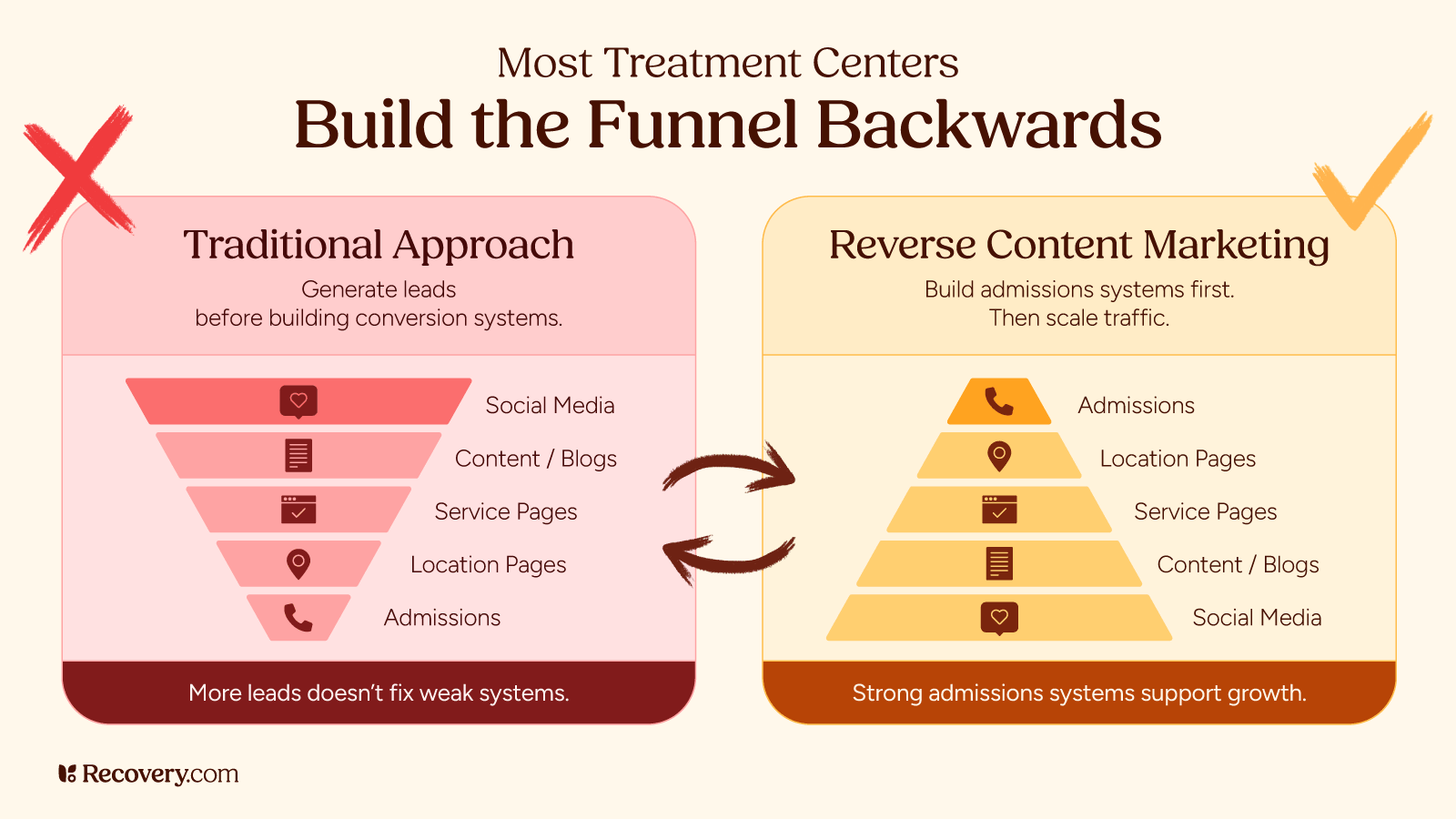
Everyone in treatment center marketing wants to start here: post every day, grow the following, go viral. I get it. But the truth is that social media is usually the last thing you should do, and when you do it, you want it to feel almost effortless.
By the time you reach Step 6, you already have everything you need. Take the obstacle-overcome content from Step 5 and repurpose it. Turn your most common questions and answers into short videos. Turn your quiz into a swipe-through carousel. Post your VOB page video natively. Pull a clip from an alumni testimonial. Answer people's questions. Be genuinely helpful.
The goal of social media for a treatment center is not to go viral. It is to show up consistently for people who are already looking for you, to build credibility, and to give your admissions team a library of content they can share in their outreach. Because you did the foundational work first, everything you post now reinforces a single consistent message: the same message someone hears when they call, read your location page, or watch a testimonial. That is how content compounds.
The Highest-Impact Asset: Alumni Testimonials
I want to tell you about something that can save you a significant amount of money while adding one of the most powerful content assets you can have: alumni testimonials.
There is nothing more persuasive than a person in recovery explaining, in their own words, how your treatment center changed their life. These should be everywhere: on your location pages, your thank-you pages, your VOB form, and your social channels.
The problem is that most treatment centers do not have a video team, a studio, or the bandwidth to produce these well. That is where Recovery.com comes in. We will film, edit, and promote your center's alumni testimonials completely free.
We have a studio in Madison, Wisconsin, and we know exactly which questions to ask to draw out authentic, compelling stories. Every person who comes in tells us afterward that it was a great experience. After filming, we edit the video, write an article based on their story, backlink to your website (great for SEO), and promote it across our social channels. We share all of that content with you so you can use it across your own website and socials too. This applies to both addiction and mental health alumni. Our only ask is that the person is at least one year into their recovery journey.
When I worked at a treatment center, a single day of professional video production like this would run about $10,000. We are offering it free. If you want to set this up, email me directly at [email protected] and we will get you on the calendar.
One center recently took me up on this and is bringing in 10 of their alumni. The more, the better. Bring everyone you want, because the better your marketing, the more people you can reach, and the more people you can reach, the more lives you can change.
Our Promise
How Is Recovery.com Different?
We believe everyone deserves access to accurate, unbiased information about mental health and recovery. That's why we have a comprehensive set of treatment providers and don't charge for inclusion. Any center that meets our criteria can list for free. We do not and have never accepted fees for referring someone to a particular center. Providers who advertise with us must be verified by our Research Team and we clearly mark their status as advertisers.
Our goal is to help you choose the best path for your recovery. That begins with information you can trust.