Find Treatment By
Rehabs by Location


Find Treatment By
Learn
About Us
Recovery.com combines independent research with expert guidance on addiction and mental health treatment. Our mission is to help everyone find the best path to recovery through the most comprehensive, helpful network of treatment providers worldwide.
Advisory Council
Our advisory council brings together leaders in behavioral health, technology, and business. Their diverse expertise ensures our resources and product are innovative, evidence-based, and effective. They guide our mission as accomplished individuals dedicated to improving the landscape of addiction recovery and mental wellness.
EFT Tapping for Depression and Anxiety: How Emotional Freedom Technique Reduces Stress and Boosts Hope


Terry McGuire is an award-winning journalist and news anchor turned mental health and hope advocate. The Giving Voice to Depression podcast that she created and cohosts has been downloaded more than 2.5 million times, and ranks in the top 1% of global podcasts.
Terry McGuire is an award-winning journalist and news anchor turned mental health and hope advocate. The Giving Voice to Depression podcast that she created and cohosts has been downloaded more than 2.5 million times, and ranks in the top 1% of global podcasts.
Table of Contents
- 1. Tapping Is a Free and Accessible Tool Anyone Can Learn
- 2. Tapping Lowers Cortisol and Helps the Body Calm Down
- 3. Tapping Helps People Acknowledge Reality Without Sugarcoating
- 4. The Tapping Sequence Targets Meridian Points to Calm the Body
- 5. Tapping Can Be Done for Any Issue: Pain, Grief, Anxiety, Depression
- 6. Tapping Helps Reduce the Emotional Charge Around Old Pain
- 7. Tapping Helps Separate Identity from Depression
- 8. The Guided Session in the Episode Helps Listeners Feel Better
- 9. Even Tiny Improvements Are Evidence of Hope
- 10. Tapping Is Something You Can Do Even When You Can’t Do Anything Else
This article summarizes a conversation on the Giving Voice to Depression podcast, hosted by Terry McGuire and Bridget, Terry's sister and the podcast's original co-host. Each week, the podcast features a guest with lived experience or professional expertise, and together they explore honest, hopeful ways people manage depression. In this episode, master tapping teacher Brad Yates offers practical instruction and a full guided session on EFT (Emotional Freedom Technique) — commonly known as tapping.
Tapping is widely used to reduce stress, ease emotional pain, and build hope. For many people, it has become a simple and portable tool they return to again and again when symptoms flare or life becomes overwhelming. And as Terry and Bridget point out, it can be done anywhere — even from bed.
Below are the major takeaways from the episode, organized in a listicle format for clarity and ease.
1. Tapping Is a Free and Accessible Tool Anyone Can Learn
One reason tapping is so widely used is that it’s simple, adaptable, and doesn’t require either money or outside support.
Bridget emphasized how easy it is to begin:
It doesn’t cost anything. You can learn it online and it’s completely portable.
People can tap at home, at work, in bed, or while sitting in the car. There’s no barrier to access, which is especially meaningful for those living with depression, who often feel that even small steps can be too big.
Key benefits of tapping’s accessibility include:
- No appointments required
- No cost
- No specialized training
- Can be done silently or out loud
- Can be done in minutes
During the episode, Terry joked that if listeners could see her and Bridget tapping along, they would probably laugh. But that’s part of the charm. There is no perfection required — just participation.
2. Tapping Lowers Cortisol and Helps the Body Calm Down
During the conversation, Brad explained that tapping is not just emotional. There is strong physiological evidence that it helps the body move out of stress mode.
Brad explained:
We have scientific evidence showing that when we're doing the tapping, we're lowering cortisol… as we clear that stress out, we naturally experience a greater sense of well-being, both physically and emotionally.
This matters because stress is often the ignition source for depression and anxiety.
When cortisol quiets down, the nervous system can settle. People often report feeling:
- more relaxed
- slightly lighter
- clearer
- less overwhelmed
Even small changes matter. Brad shared how meaningful a small shift can be:
Even if we go from a nine down to an eight point seven five… that’s a little bit of relief. And it’s evidence that if I can bring it down even a little bit, that means I can bring it down even more.
That tiny degree of relief often carries hope, which is central to this podcast.
3. Tapping Helps People Acknowledge Reality Without Sugarcoating
Unlike affirmations that leap instantly to positivity, tapping begins with truth. People are encouraged to name their emotional pain honestly.
Bridget highlighted this approach:
You’re not candy-coating it. You’re acknowledging what’s not working and how you’re feeling and you’re starting with that.
This can feel surprising. Many assume that healing tools avoid negative thoughts. But tapping begins with:
- “I feel down.”
- “I’m stressed.”
- “Something is really bothering me.”
Brad illustrated why honesty matters with a simple metaphor:
If your dog poops on your carpet, you can’t pretend it’s not there. You have to say it’s there, I’m gonna clean it up, and then it’s gone.
Naming is not wallowing.
It is the first step toward clearing.
4. The Tapping Sequence Targets Meridian Points to Calm the Body
During the episode, Brad walked listeners through a full tapping sequence. The rhythm is gentle, using fingertips on key meridian points:
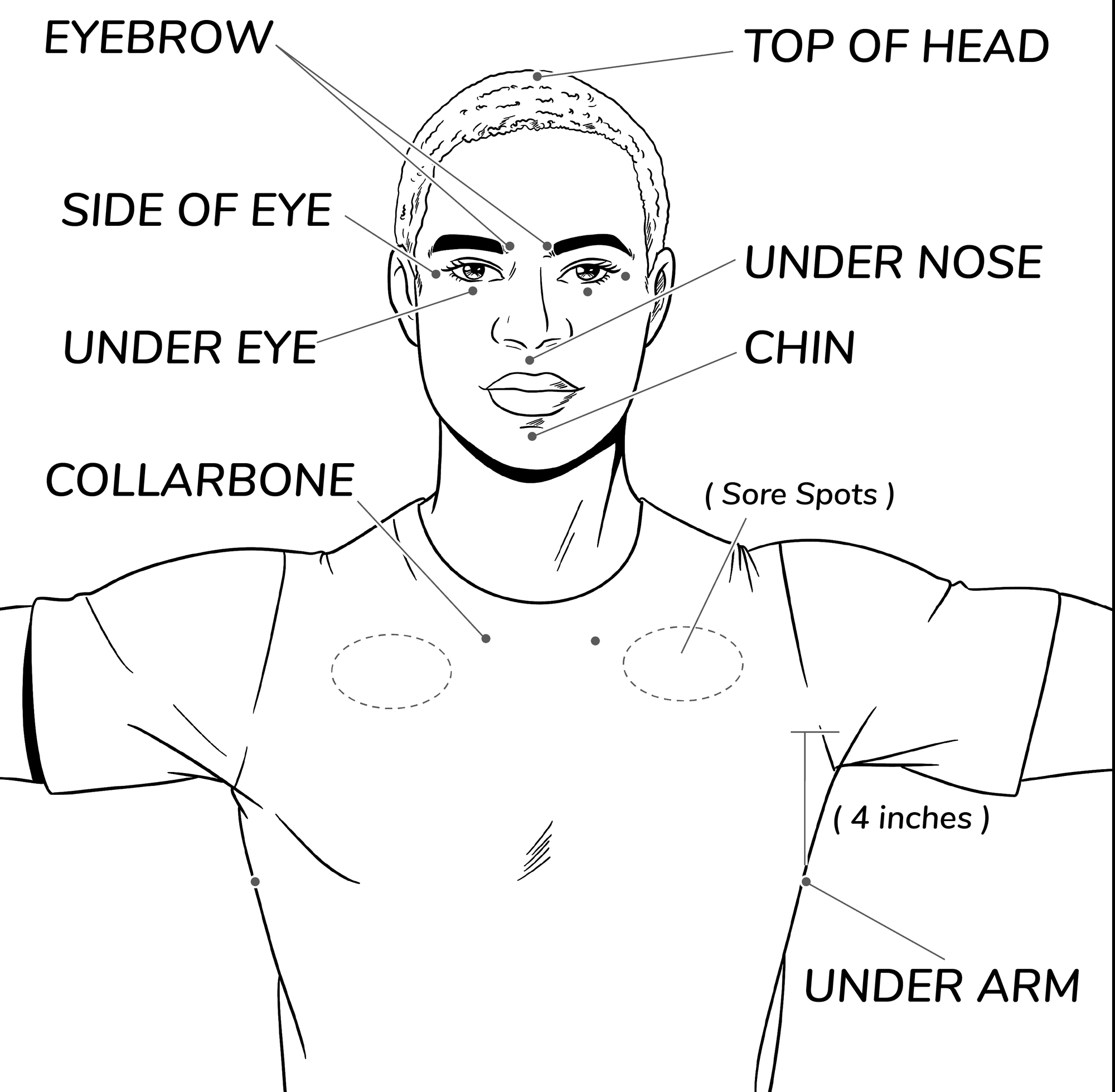
Tapping points:
- Side of the hand (karate chop)
- Eyebrow start
- Side of the eye
- Under the eye
- Under the nose
- Chin
- Collarbone area
- Under the arm (bra-strap level)
- Top of the head
Each tap is paired with a phrase acknowledging what’s being felt:
- all this stress
- I’m feeling down
There is no need to memorize anything. It becomes intuitive through practice.
Bridget reminded listeners that a chart will be provided because visuals help it “come together” — but tapping works even if the exact points aren’t perfect. Participation matters more than precision.
5. Tapping Can Be Done for Any Issue: Pain, Grief, Anxiety, Depression
Brad has created more than 800 guided tapping videos for:
- grief
- pain
- fear
- self-worth
- money stress
- depression
People often feel at least some relief after just a few minutes.
Brad noted how quickly tapping can help:
Even after just a few moments of tapping, we tend to feel more relaxed and start to experience a little bit more well-being.
Some listeners feel skeptical at first. Co-host Terry McGuire even admits she was one of them. But she explained how tapping surprised her:
I tried this with a generous dose of skepticism. But I’ll be darned if it hasn’t actually worked every single time I’ve tried it.
The combination of curiosity and lived experience makes tapping approachable, not mystical.
6. Tapping Helps Reduce the Emotional Charge Around Old Pain
Depression often links back to old experiences that never fully resolved.
Brad explained:
Often in cases of depression, what we’re feeling depressed about are things that we never really resolved from way back in the past.
We learn early — through conditioning, culture, or family — that we are supposed to feel bad about certain events. But tapping helps people question that assumption.
Brad asked a gentle but important question:
Isn’t it possible that I could heal? Isn’t it possible that I could feel good?
Through repetition, people soften the inner narrative that keeps them stuck.
7. Tapping Helps Separate Identity from Depression
One of the most powerful shifts Brad described is moving from identity to experience.
Instead of saying:
- I am depressed
people begin to say:
- I sometimes struggle with depression
Brad emphasized this difference:
It doesn’t have to be a part of my identity such that I need to hang on to it.
This shift opens space for:
- acceptance
- self-care
- treatment
- hope
Depression becomes something a person experiences, not something they are.
8. The Guided Session in the Episode Helps Listeners Feel Better
Brad led a full tapping round focused on feeling down. The session begins with self-compassion:
Brad began by affirming self-acceptance:
Even though I’m feeling down, I choose to love and accept myself.
He explores why the mind believes sadness is required:
- that it is “appropriate”
- that there is no choice
- that feeling better might be unsafe
Then he invites gratitude:
Brad reflected on the simplest gratitude:
I like just the fact that I’m breathing right now. And every time I inhale, the universe supplies me with oxygen.
He expands into self-worth:
Brad ended the round with a powerful statement:
I am tapping into the truth I am a magnificent child of the universe and I am worthy and deserving of love and joy.
Simple words.
Radically healing.
9. Even Tiny Improvements Are Evidence of Hope
Hope is central to every episode. Listeners often live with conditions that make hope feel impossible.
Brad pointed out that even tiny improvements matter:
Even if we go from a nine down to an eight point seven five… that’s a little bit of relief and it’s evidence that if I can bring it down even a little bit, that means I can bring it down even more.
Bridget responded warmly:
We’re all about hope, hope, hope.
Hope is not a cure.
But it is a starting point.
10. Tapping Is Something You Can Do Even When You Can’t Do Anything Else
Depression often makes everyday action feel impossible. That’s why tapping is so valuable.
Bridget reflected on its simplicity:
When you're stuck in the depths of depression, it doesn’t feel like you can do anything. You could do this from bed.
There is no requirement to:
- shower
- get dressed
- leave the house
- speak to anyone
Brad emphasized the gentleness of what tapping offers:
It’s something to take a little bit of edge off the pain.
For many, that is enough.
Conclusion: Try It, Notice What Happens, and Stay Curious
The episode ends with an invitation to experiment. Terry and Bridget encourage listeners to share whether tapping helped and to suggest other tools they would like covered.
Bridget expressed the spirit of the podcast:
We all just need stuff that works. So let us know what works for you.
Tapping is not a cure.
It is a tool — portable, free, gentle, and hopeful.
It is something you can do:
- when you feel down
- when stress spikes
- when you can’t get out of bed
- when you don’t know what else to do
The goal is not perfection.
The goal is one small breath of relief.
Brad offered the simplest guidance:
Lather, rinse, repeat as necessary.
Our Promise
How Is Recovery.com Different?
We believe everyone deserves access to accurate, unbiased information about mental health and recovery. That's why we have a comprehensive set of treatment providers and don't charge for inclusion. Any center that meets our criteria can list for free. We do not and have never accepted fees for referring someone to a particular center. Providers who advertise with us must be verified by our Research Team and we clearly mark their status as advertisers.
Our goal is to help you choose the best path for your recovery. That begins with information you can trust.