Find Treatment By
Rehabs by Location


Learn
About Us
Recovery.com combines independent research with expert guidance on addiction and mental health treatment. Our mission is to help everyone find the best path to recovery through the most comprehensive, helpful network of treatment providers worldwide.
Advisory Council
Our advisory council brings together leaders in behavioral health, technology, and business. Their diverse expertise ensures our resources and product are innovative, evidence-based, and effective. They guide our mission as accomplished individuals dedicated to improving the landscape of addiction recovery and mental wellness.
Depression Help: 12+ Ways to Manage Suicidal Thoughts and Find Support


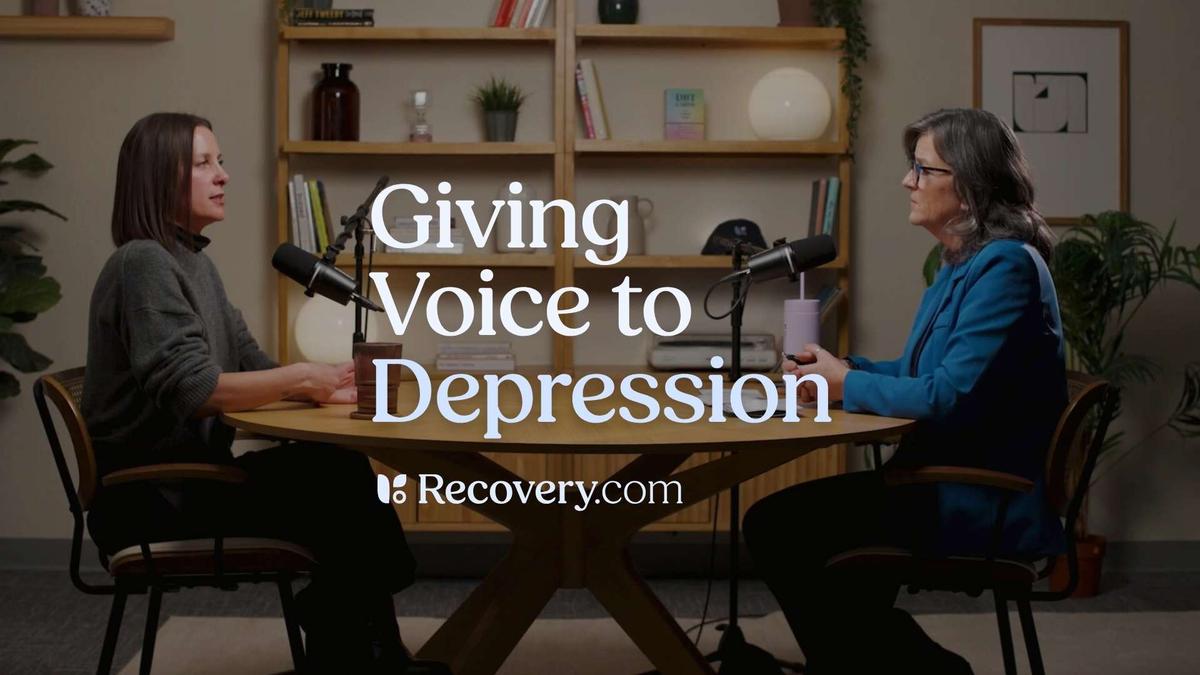
This article is a summary of a conversation from the Giving Voice to Depression podcast hosted by Terry McGuire. In this episode, Terry shares a conversation from her other podcast, Recoverable, with licensed therapist Aja Chavez about what depression is, what it is not, how suicidal thoughts can show up, and what kinds of support can actually help.
Aja speaks both as a therapist and as someone who has survived depression and a suicide attempt. That combination gives the episode its power: it is clinical, personal, direct, and deeply compassionate.
1. Depression Is Not Laziness
Aja begins by naming what depression is not: laziness.
That distinction matters because so many people with depression are judged as unmotivated, dramatic, weak, or unwilling to help themselves. But depression is a medical condition that affects thinking, mood, energy, sleep, appetite, relationships, and the ability to function.
Aja clarified early in the conversation:
It is not laziness. We talked quite a bit about that and how it is quite different. It’s also not just persistent sadness. Depression is something that impacts all areas of functioning in our lives. It is a medical condition that either has a huge impact in ability to function.
That framing can help reduce shame. Someone who cannot get out of bed may not be refusing life. They may be experiencing an illness that has taken away access to the energy, clarity, and hope they normally rely on.
2. Depression Can Look Very Different
One of the most important points in the conversation is that depression does not have one single appearance.
For some people, it looks like being unable to function. For others, it hides behind high achievement and outward success.
Aja described this range:
There’s depression that kind of comes and goes, there’s a cyclical pattern to it. There’s depression that is coupled with mania. There is depression that is just pervasive and persistent — long periods of time. There is depression that takes someone down at their knees and it maybe looks and we can see it and it is clear that this person is not well and not okay. And then depression can also show up with someone who is very high achieving and everything looks perfect and pristine on the outside.
This matters because many people miss depression in those who appear “fine.”
3. Depression Often Changes Someone’s Normal
Aja emphasizes that one of the clearest indicators of depression is a shift from someone’s baseline.
That shift might be emotional, behavioral, or relational.
Aja explained how it shows up for her:
It’s not always going to look like sadness. You and I talked about how it shows up as irritability. I’m not kind when depression starts to set in. I want everyone to go away. And I want to make it really clear it’s their fault.
This honesty helps people recognize depression beyond stereotypes.
4. The Thoughts Are A Major Symptom
Terry highlights something often overlooked: the internal thoughts of depression.
These thoughts can be relentless, convincing, and deeply painful.
As Terry described from her own experience:
That you’re a burden, that you’ll always feel this way, that nobody understands, that nobody cares and they’d all be better off without you. Those are huge and they’re so convincing and it’s just on a loop.
These thoughts are not just passing worries. They are often core drivers of suffering.
5. Depression Uses Shame To Silence People
Aja explains why people don’t talk about these thoughts: shame.
That shame keeps the thoughts hidden, which allows them to grow stronger.
Aja explained:
We don’t talk about those thoughts because we are deeply ashamed of them. It’s like depression showing up in one more way of silencing us.
She goes further, describing how people internalize those thoughts:
We believe that all of those thoughts are true. That I am not enough. I am a burden. I am the only one in the world that feels and experiences this. And I feel and experience this because there is something innately wrong and flawed with me.
Naming these thoughts is often the first step toward weakening them.
6. 988 Is Not Only For Emergencies
The conversation introduces 988 as a critical support resource.
Importantly, it is not just for people on the verge of suicide.
Aja clarified:
You don’t have to be on the verge of a suicide attempt to utilize that hotline. These are folks who are trained to help you understand you, your thought process, what you’re feeling, what you are experiencing, and put your hand in the hand of someone else who can help.
She also emphasized how accessible it is:
When you are riddled with depression, can you imagine how difficult it is to identify a therapist, pick up the phone, get on the internet? That process alone is a lot of steps if you cannot get out of bed. 988 can be wildly helpful.
7. Depression Requires Ongoing Management
Terry asks whether depression ever goes away.
Aja offers an honest answer.
Aja shared:
I really wish I could say yes. But it’s not something that we are ever fully cured from. I think of it as something like being in remission. Depression is something that kind of remains with us and it’s going to have its ebbs and its flows.
She adds a critical warning:
The second I feel that I’m cured and it no longer exists is the moment that it invites itself back in because I stopped doing all of the things that I need to do to keep myself well.
This reframes depression as something that can be managed, not ignored.
8. Supporting Someone Means Going Deeper
When someone says “I’m fine,” it is often not the end of the story.
Aja encourages people to trust their instincts.
Aja explained:
If you are asking someone how they are doing, you already know. You probably have already seen some indicators that something is off.
She advises continuing the conversation:
There is nothing we want more than to be seen and to be understood and to be heard. And yet when someone comes in and sees us, we immediately reject it.
Supporting someone means staying present even when it’s uncomfortable.
9. Therapy Access May Need Practical Help
Finding therapy can be overwhelming, especially during depression.
Aja acknowledges this reality:
Many times it’s not going to be the individual who is struggling themselves that are going to be able to do the seeking and the navigating. It’s really going to be asking someone to help you.
She encourages reaching out:
If there is someone that you can invite in to help you and you can ask, please do that. Please ask someone for that help to get you at least into the care of someone who can get you on a path.
Support often means helping with logistics, not just emotions.
10. Hope Often Starts Very Small
Hope does not always arrive as a big shift.
Instead, it often begins with small moments of feeling.
Aja described this beautifully:
Joy and sadness coexist at the same time. You can be very depressed and still have glimmers of joy.
She explains how this builds:
That warmth, that tingly feeling, that is what will start to build up into hope. Joy comes before hope many times.
These small experiences matter more than they seem.
11. Medication Can Provide Stability
Medication is discussed as one possible tool — not the only one, but an important one.
Aja shared her personal experience:
Medication saved my life. Being willing to be on the path of finding the right medication that works for you is so key.
She also acknowledges the difficulty:
The first medication that you take might not always be the one that’s going to be the game changer right out of the gate. That was really frustrating for me.
Terry adds her perspective:
I found a bit of comfort in the fact that meds worked because it confirmed for me that it wasn’t just in my head. That there was something physical, something medical, something biological about it.
Medication, for some, provides the foundation needed to heal.
12. Speaking Up Can Interrupt Depression
The final and most critical takeaway is simple — but not easy:
Speak up.
Aja is clear about what happens when people stay silent:
Secrecy is the invitation for depression and hopelessness to get bigger and bigger.
She encourages direct conversation:
If you have that trusted person or you have a therapist, please name that. It will get bigger and it will get louder the more that we silence it.
And for those afraid to ask someone else directly, Aja offers reassurance:
There is nothing that we want more as humans to be seen and to be heard and to be understood. We might not like you in the moment when you ask that, but we will love you later on.
That is the heart of this episode.
Final Thoughts
This conversation offers clarity, compassion, and practical guidance.
It reminds us that:
- Depression is real and medical
- Thoughts are symptoms, not truths
- Support must be intentional and active
- Small steps matter deeply
- Speaking up can save lives
Most importantly, it reinforces one truth:
No one should face depression alone.
Our Promise
How Is Recovery.com Different?
We believe everyone deserves access to accurate, unbiased information about mental health and recovery. That's why we have a comprehensive set of treatment providers and don't charge for inclusion. Any center that meets our criteria can list for free. We do not and have never accepted fees for referring someone to a particular center. Providers who advertise with us must be verified by our Research Team and we clearly mark their status as advertisers.
Our goal is to help you choose the best path for your recovery. That begins with information you can trust.