Find Treatment By
Rehabs by Location


Learn
About Us
Recovery.com combines independent research with expert guidance on addiction and mental health treatment. Our mission is to help everyone find the best path to recovery through the most comprehensive, helpful network of treatment providers worldwide.
Advisory Council
Our advisory council brings together leaders in behavioral health, technology, and business. Their diverse expertise ensures our resources and product are innovative, evidence-based, and effective. They guide our mission as accomplished individuals dedicated to improving the landscape of addiction recovery and mental wellness.
Why Do Men Struggle With Mental Health? 10 Expert Answers On The Internet’s Most Searched Men’s Mental Health Questions


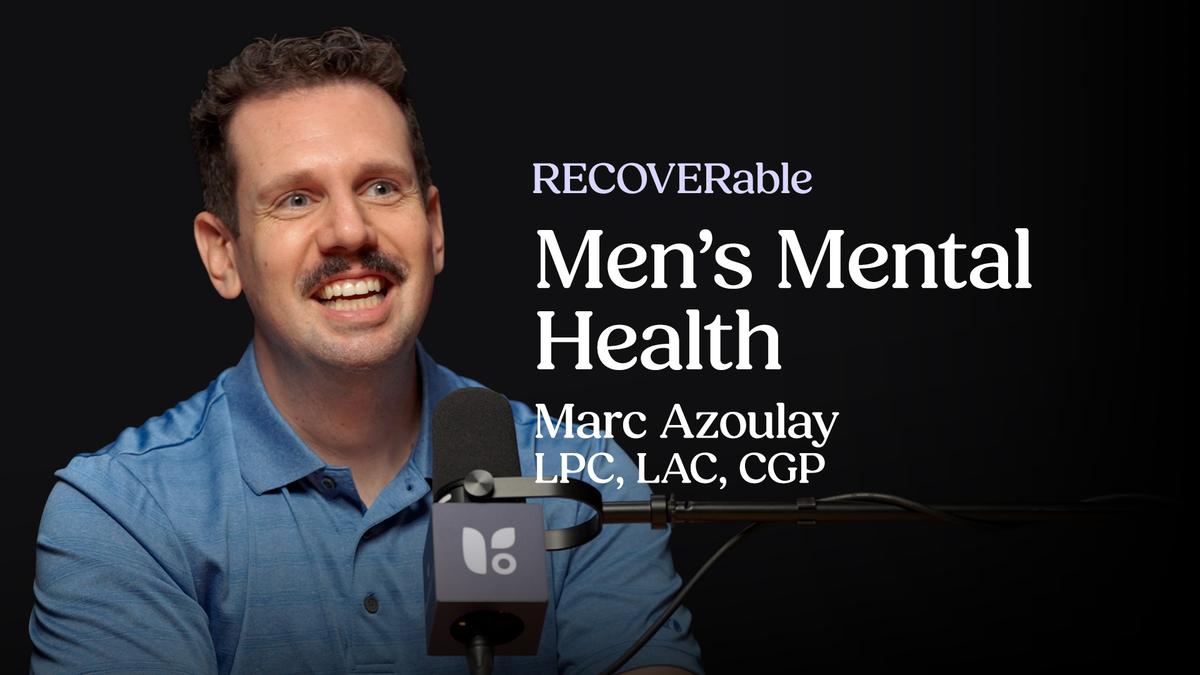
A man struggling with his mental health may never say, “I’m not okay.” He may say he’s exhausted. He may work later, spend more time alone, become increasingly irritable, drink more often, disappear into a hobby, or seem angry at everyone around him.
Psychotherapist Marc Azoulay believes those behaviors may sometimes be a form of communication.
“They are communicating it to you. They’re just not saying it,” Azoulay explains in this episode of Recoverable.
Host Terry McGuire sits down with Azoulay to explore some of the most searched questions about men’s mental health, including why men struggle to express emotions and how loneliness, work stress, self-reliance, and traditional ideas about masculinity can affect emotional well-being.
1. Why Is It So Hard for Men to Say “I’m Not Okay”?
For some men, admitting they are struggling can feel like admitting they have failed.
Azoulay says many men grow up learning that they should be the provider, problem-solver, protector, or “rock” that everyone else depends on. Unfortunately, that can make emotional struggle feel incompatible with the role they believe they are supposed to play.
“It’s really hard to say I’m not okay, because for a man that feels like failure,” Azoulay says.
Azoulay says some men worry that admitting they are struggling means they are letting down their spouse, children, coworkers, and others who rely on them. If they also believe no one will be able to help, there may seem to be little reason to speak up in the first place.
He connects that pressure to lessons men may absorb early in life about strength, crying, and emotional expression. When McGuire asks what he was taught as a young boy about crying and sharing his feelings, Azoulay’s answer is simple: “Don’t do it.” He recalls learning, both explicitly and indirectly, that emotional expression could be interpreted as weakness.
2. What Are the Signs a Man Is Struggling Emotionally?
The words may be missing, but the behavior often is not.
Azoulay points to overworking, irritability, anger, isolation, low energy, drinking, heavy screen use, and becoming consumed by one activity as possible signs that something deeper is happening.
A man who repeatedly says he is tired or exhausted, starts turning down social plans, becomes increasingly short-tempered, or seems angry at everyone around him may be communicating distress without naming it that way.
Azoulay also points to substance use and other forms of escape. Drinking every night, needing alcohol or another substance to feel comfortable socially, or retreating heavily into gaming, pornography, work, or another activity can sometimes serve as ways to avoid uncomfortable thoughts and feelings.
His larger point is that men may communicate distress through actions before they communicate it directly with words. Rather than waiting for someone to say, “I need help,” it may be important to pay attention to changes in behavior, relationships, routines, and coping habits.
3. What Does Depression Look Like in Men?
Depression does not always look like obvious sadness.
Azoulay says people often imagine depression as someone who looks sad, withdraws completely, or struggles to get out of bed. While depression can certainly look that way, he says emotional distress in men may also appear as social withdrawal or an increasingly narrow focus on one part of life.
A man might appear highly productive because he is spending nearly all of his time at work. Another might spend hours gaming, exercising, working on his car, or pursuing one hobby while gradually disengaging from relationships and other activities.
Azoulay describes this pattern as becoming “mono focused.” Instead of moving comfortably between relationships, responsibilities, interests, health, and recreation, a man may begin relying almost entirely on one area of life.
From the outside, that intense focus can look like motivation or passion. However, Azoulay’s point is that the broader context matters. If everything else in a person’s life is shrinking around that one activity, it may be worth asking what else is going on.
4. Can Work, Exercise, or Hobbies Become Emotional Avoidance?
Healthy outlets can become unhealthy when they become the only outlet.
Azoulay is not suggesting that exercise, hobbies, or hard work are inherently harmful. In fact, he speaks positively about going to the gym, working with your hands, having hobbies, and feeling productive.
The issue is when one activity becomes the only way someone manages stress or uncomfortable emotions.
“When that’s the only thing you’re doing and not actually addressing what’s really going on, it’s only a Band-Aid,” he says.
For example, a hard workout may provide temporary relief from anxiety. Staying late at work may offer a distraction from relationship problems. Spending hours in the garage may create distance from an uncomfortable conversation. None of those activities is automatically unhealthy, but repeatedly using them to escape the underlying problem may prevent someone from addressing it.
The important question is whether the activity adds to someone’s life or has started replacing relationships, rest, emotional processing, and other needs.
5. Why Are So Many Men Lonely?
You can be surrounded by people and still feel deeply alone.
Azoulay makes an important distinction between loneliness and social isolation.
A man can have coworkers, family, friends, a church community, or social groups and still feel lonely if he does not feel able to talk honestly about what is happening internally. Being around people and feeling known by those people are not necessarily the same thing.
Azoulay describes many men as constantly “performing” success, confidence, strength, and competence. They may feel pressure to appear as though they always know what to do, never need help, and never become a burden to someone else.
That performance can become exhausting when there is nowhere to take the mask off.
Azoulay also argues that men may limit what they reveal about themselves in other ways, including their interests, insecurities, disagreements, or personal struggles. Over time, that can create a situation where someone has plenty of people around him but very few relationships in which he feels fully known.
6. Why Can Male Friendships and Group Support Matter for Mental Health?
Connection does not always have to start with a deep conversation.
Azoulay says many men connect “side by side” through shared activities such as golf, sports, exercise, cars, or hobbies.
Those relationships matter even when the conversation initially stays focused on the activity itself. His hope is that side-by-side connection can eventually create enough trust for more direct, face-to-face conversations.
He is especially supportive of men’s groups because they combine connection with accountability. Seeing other men openly discuss marriage problems, parenting struggles, drinking, work, or emotional challenges may make it easier for someone to realize that he is not the only person dealing with them.
Azoulay describes the realization that you are not the only person struggling feeling like a “big exhale.”
Groups can also move beyond insight and into action. Another man can ask whether you actually had the difficult conversation you said you were going to have or followed through on a change you wanted to make. For Azoulay, that mixture of honesty, peer support, and accountability can be especially valuable.
7. Does Therapy Work for Men?
Therapy may connect better when it feels active, practical, and goal-oriented.
Azoulay argues that some men disengage from traditional talk therapy because it can feel unfamiliar, passive, or disconnected from the way they approach other problems.
He says some men respond better to action-oriented or experiential approaches, including group work, nature-based activities, goal-setting, and direct accountability.
He also believes therapy can help men move from understanding a problem to doing something about it. Learning why you respond a certain way or how past experiences shaped you can be valuable, but Azoulay wants that insight to eventually lead to questions such as: What are you going to change? What conversation do you need to have? What skill do you need to practice?
His broader point is not that men cannot talk about emotions. It is that the framing may matter. Words like honesty, courage, challenge, growth, accountability, and skill-building may resonate differently than simply telling someone to “be vulnerable.” Azoulay often frames emotional work as another set of skills that can be practiced and improved.
8. How Can You Encourage a Man to Get Help Without Making Him Feel Broken?
Concern may be more effective when it is paired with partnership.
Azoulay recommends being direct about what you are noticing while also making it clear that the person is not being abandoned to handle the problem alone.
The message can be closer to: I can see you’re struggling. I care about you. What are we going to do about this together? That is very different from telling someone that he is broken and needs to fix himself.
Azoulay describes this as a combination of compassion and accountability. Loved ones do not have to pretend that concerning behavior is fine, but they also do not have to approach the conversation with shame or rejection.
Support might involve therapy, talking more openly, exercising together, reconnecting socially, or addressing one concrete problem that has become difficult to manage.
Azoulay also cautions loved ones against becoming the only source of emotional support. A partner can care deeply about someone without becoming responsible for managing every problem, covering for harmful behavior, or shielding the person from every consequence. Expanding the support system can be part of getting better.
9. When Does Self-Reliance Become Unhealthy?
Strength becomes limiting when you can never turn it off.
Azoulay does not describe self-reliance itself as a problem. Being dependable, capable, strong, and skilled can be valuable qualities. The problem begins when a man feels he must handle every part of life alone, always know the answer, and never need support.
His answer to when self-reliance becomes harmful is simple: “When you can’t turn it off.”
Azoulay points to an almost impossible image of modern success, the man who is physically fit, successful at work, completely present for his children, financially secure, well-traveled, confident, and capable of handling nearly anything.
Social media can make that combination appear achievable, even normal. In reality, no one can master every area of life or be everything to everybody.
When asking for help starts to feel unacceptable, independence can stop functioning as a strength and start becoming a restriction.
10. What Would Azoulay Tell a Young Man Who Feels Hopeless?
Don’t give up.
That is Azoulay’s direct answer.
He describes young men who are highly aware of economic uncertainty, technology, climate concerns, war, politics, and other enormous problems. Some become so focused on everything that appears wrong with the world that they begin asking what the point is of building a career, getting an education, forming relationships, or planning for the future.
Azoulay says he understands how someone can arrive at that conclusion. But his advice is to bring the scale down.
“You can build the reality and the little utopia that you want,” he says. “It’s just on a smaller scale.”
Meaning does not have to come from solving a global problem. It can come from relationships, family, community involvement, meaningful work, mentors, or improving the small part of the world within reach.
He also challenges the idea that a meaningful life must be extraordinary. For a young man who feels pressure to accomplish something huge or not bother trying at all, building a stable, connected, fulfilling life can itself be worthwhile.
Final Thoughts
One idea runs through nearly every part of Azoulay’s conversation: improving men’s mental health does not have to mean asking men to become less strong. Instead, it may mean expanding the definition of strength.
Strength can include recognizing when anger is covering something deeper, or when work has started becoming all-consuming. It can mean maintaining friendships where someone will challenge you, admitting when you do not have the answer, or asking for help before a crisis forces the issue.
Azoulay’s central message is that men can learn to understand what emotions are signaling, respond to them more deliberately, and then decide what to do next. In that sense, emotional awareness can become part of problem-solving rather than the opposite of it. The goal is not simply to get men talking. It is to help them build lives in which they do not have to struggle alone.
Our Promise
How Is Recovery.com Different?
We believe everyone deserves access to accurate, unbiased information about mental health and recovery. That's why we have a comprehensive set of treatment providers and don't charge for inclusion. Any center that meets our criteria can list for free. We do not and have never accepted fees for referring someone to a particular center. Providers who advertise with us must be verified by our Research Team and we clearly mark their status as advertisers.
Our goal is to help you choose the best path for your recovery. That begins with information you can trust.