Find Treatment By
Rehabs by Location


Learn
About Us
Recovery.com combines independent research with expert guidance on addiction and mental health treatment. Our mission is to help everyone find the best path to recovery through the most comprehensive, helpful network of treatment providers worldwide.
Advisory Council
Our advisory council brings together leaders in behavioral health, technology, and business. Their diverse expertise ensures our resources and product are innovative, evidence-based, and effective. They guide our mission as accomplished individuals dedicated to improving the landscape of addiction recovery and mental wellness.
From BHT to Chief Strategy Officer: How Matt Amato Helped Scale All In Solutions to 240 Beds


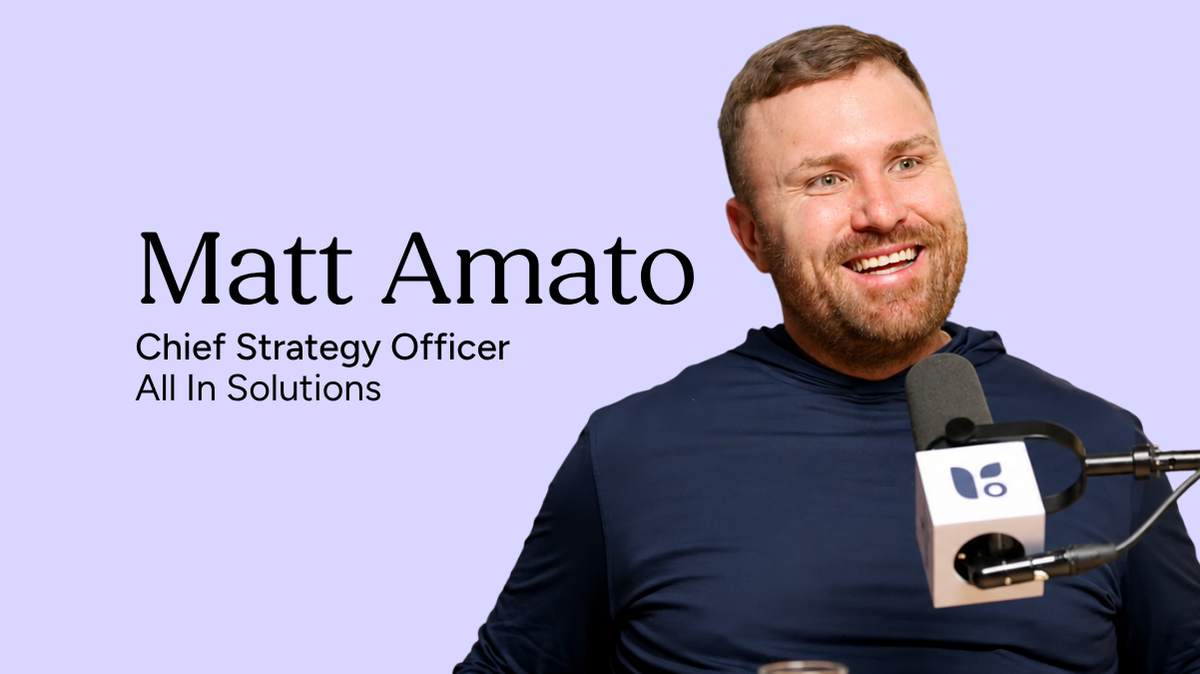
Matt Amato has been through startups. He has helped open programs from scratch. So when he says that acquiring an existing treatment facility is "monumentally harder" than launching a new one, it carries weight.
"You're dealing with clients who've still been in the facility, who you still have to treat," says Amato, Chief Strategy Officer at All In Solutions. "You're dealing with staff who are feeling super uneasy about what's going on. You're dealing with cultural shifts, and you're dealing with a shift in how departments communicate."
His conclusion sounds like something you'd hear in a 12-step meeting, and that's not an accident: "You can't rush the process. You just have to go through the process one day at a time."
On this episode of Recovery Reach, Amato sat down with host Cliff McDonald to talk about scaling a treatment organization across three states, why family involvement is the field's most underrated lever, and how a job as a behavioral health technician turned into a seat in the C-suite.
From 1 Program to 240 Beds Across 3 States
All In Solutions started in 2012 as a small PHP and IOP program in South Florida. Today the organization operates a full continuum in every state it serves:
- Detox, residential, PHP, and IOP in South Florida (Boynton Beach and West Palm Beach)
- A substance abuse PHP and IOP in Cherry Hill, New Jersey
- A detox and residential program in North Jersey and a mental health partial program in Eatontown, acquired last June
- A 24-bed detox and residential facility plus a 45-bed PHP and IOP program in Ventura County, California
That adds up to roughly 240 beds, with most of the growth coming in the last three or four years.
The expansion has been deliberate rather than aggressive. "We don't just expand just to expand," Amato says. "We don't expand just to say, hey, we can fill X more beds. It's like, why does this make sense? What's the long term?"
He credits ownership with modeling that patience. "Just because it might make sense from a business standpoint doesn't mean it makes sense for the organization at its current state."
The Acquisition Playbook: Honesty From Day One
When All In Solutions took over two New Jersey facilities in a single acquisition last June, the team walked into every problem an operator can imagine, plus a few nobody planned for. Snow plow contracts that existed on paper but not in practice. An air conditioning system at the clinical building that quit in week two. Staff who had been told one thing by previous ownership and were bracing to be told another.
"Everyone thinks they're getting fired," Amato says.
The counterweight was communication. Leadership met face to face with the inherited staff and laid out the vision for month one, month three, and month six. Questions got an open door instead of a runaround.
"The one thing that everyone says is they know there was an honest effort to communicate everything that had happened, from the day the acquisition happened until where we are today," he says. "And a lot of those people are still here."
Many of them are doing more than sticking around. Amato says the acquisition surfaced employees whose potential had never been tapped by previous management, and developing them became part of stabilizing the sites. His approach to that development is simple: explain the why. "You can tell me, but what's the why behind it? Then I can execute better."
Why the $18-an-Hour Employee Is Your Brand
Amato's perspective on frontline staff is not theoretical. His first job in treatment was as a BHT at All In Solutions in late 2014, a couple of years into his own sobriety.
He had come to South Florida from Northeast Philadelphia, paying cash for a halfway house after multiple treatment attempts. Surrounded by a group of men who were all in recovery, he got sober and got curious about the work. He started at the bottom, worked his way up through the housing department, left for an operations and admissions role at a South Florida startup, and eventually circled back when founder and CEO Dennis offered him a bigger seat at a company that was then around 80 or 90 beds.
That path shapes how he moves through the buildings today.
"When I'm at any of the sites, I make sure I say hello to the front desk. I make sure I shake the hands of the BHTs, of whoever's there," he says. "I never wanna be the guy in a suit jacket thinking I'm above somebody."
It also shapes his conviction about where quality actually lives. "A lot of times those people are the ones who make or break a good facility."
McDonald put it even more bluntly: the people making $18 an hour, who spend 23 hours a day with your patients, are your brand.
The retention numbers suggest the culture is working. The clinical director in Cherry Hill has been there 10 years. South Florida's has been there seven or eight. Most departures, Amato says, happen when someone gets an opportunity the company simply can't match.
The Most Underrated Thing in Behavioral Health: Treating the Family
Asked what the field undervalues, Amato didn't hesitate: family involvement.
At All In Solutions, that's not a brochure line. Every program runs a weekly family Zoom meeting. Therapists are required to keep loved ones on the ROI updated on the treatment plan, discharge plan, and progress. Family sessions are encouraged, and the team proactively reaches out rather than waiting for scared family members to ask questions they don't know how to ask.
"Oftentimes they don't know any better," Amato says. "They've never been through this experience. They have questions that they're probably scared to ask. We're reaching out to them."
The clinical logic is straightforward. Addiction is a family disease, and an unchanged family system can quietly become a barrier to recovery. "It's like, if nothing changes, nothing changes. And that's just not your son, daughter, husband, wife. It's also you."
The business results followed the clinical ones. "Through family involvement, our retention's better. Our length of stay is better," Amato says. As McDonald noted, that's not just about revenue. It's about someone's experience of treatment. Going all in, in other words.
It's also genuinely differentiating, because it's hard. More communication, more stakeholders, more work. "It has to be a cultural concerted effort to really drive that point home to everybody," Amato says.
The Most Overrated Metric: Admissions Per Month
If family involvement is underrated, Amato has a clear pick for the opposite. "I think what's an overrated statistic is how many admissions you're doing per month. I think it's the most overrated thing in this industry."
The obsession with census, he argues, usually signals a deeper problem: a facility that doesn't know who it is. When clinical, admissions, business development, and operations aren't aligned, teams start forcing admissions through the door that don't make sense, just to make their stats look good.
The alternative is discipline. "When you can deny an admission because you wanna remain true to who you are as a provider, you're sticking to your beliefs," he says. "When you stick to your beliefs, I think more times than not, you're gonna be just fine."
That discipline extends to growth itself. Amato shared a lesson from CEO Mike: when the organization gets licensed for 20 new beds, maybe open eight first and see how the staff handles it. Control what you can control, because there will be plenty you can't.
What Leaders Should Be Watching: Payer Compliance and AI Audits
Amato's advice for the future of the field is less glamorous than most conference keynotes, and probably more urgent: stay compliant with payers.
Insurance companies are layering on regulations about how members should be treated, by whom, at what licensure level, and how often. If your clinical and medical documentation isn't airtight, "you're in a position of failure potentially," he says. "It's not an if, it's a when."
And he suspects the audits are about to get sharper. "I'm sure insurance companies are using AI to be like, hey, we've had a lot of claims processed at this company. Let's take a look at their charts."
For operators, compliance isn't paperwork. It's risk management for the whole business.
Sober Dad, Twin Daughters, One Day at a Time
Amato's own story runs through the height of the opiate epidemic in Philadelphia. A sports kid from a tight-knit Irish-Italian neighborhood, he drank and partied through high school but stayed away from opiates while athletics gave him structure. When high school ended and the structure disappeared, he felt lost, gravitated toward others who were lost, and tried an opiate once. "It was a wrap."
He wasn't a first-time winner. The turning point came when a sponsor called him out after his third treatment attempt: "You know everybody knows you're still getting high, right?" What finally worked was surrender. He stopped trying to outsmart the disease, took suggestions, and stopped differentiating himself from everyone else in the rooms.
Today he's engaged, with two-year-old twin daughters. He's honest about that too. "Having twins was the most beautiful thing, but the first year was the hardest thing I've ever done in my sobriety," he says. "It's been a test of patience. It's been a revealing of selfishness. It's been a revealing of what does bring me joy."
Same principle as the acquisitions. Same principle as recovery. One day at a time, with the faith that there's a light at the end of the tunnel.
Our Promise
How Is Recovery.com Different?
We believe everyone deserves access to accurate, unbiased information about mental health and recovery. That's why we have a comprehensive set of treatment providers and don't charge for inclusion. Any center that meets our criteria can list for free. We do not and have never accepted fees for referring someone to a particular center. Providers who advertise with us must be verified by our Research Team and we clearly mark their status as advertisers.
Our goal is to help you choose the best path for your recovery. That begins with information you can trust.