Find Treatment By
Rehabs by Location


Learn
About Us
Recovery.com combines independent research with expert guidance on addiction and mental health treatment. Our mission is to help everyone find the best path to recovery through the most comprehensive, helpful network of treatment providers worldwide.
Advisory Council
Our advisory council brings together leaders in behavioral health, technology, and business. Their diverse expertise ensures our resources and product are innovative, evidence-based, and effective. They guide our mission as accomplished individuals dedicated to improving the landscape of addiction recovery and mental wellness.
When Your Alumni Tattoo Your Logo on Their Body: Lessons in Scaling Behavioral Healthcare from Guardian Recovery's DJ Prince


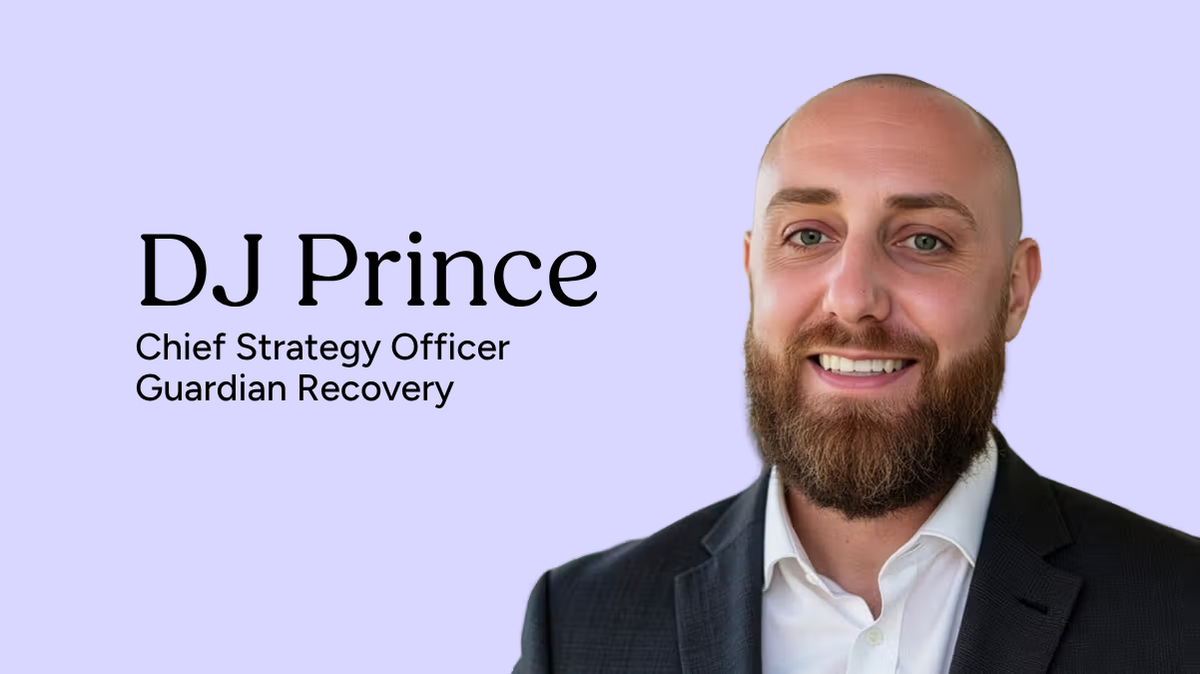
Six months before Guardian Recovery kicked off a major rebrand, DJ Prince got sent a photo that stopped the whole conversation. An alumnus had a large tattoo of the Plymouth House logo on their calf.
"How do we deal with messing with a location and a brand and a name and a logo that somebody attributes to saving their lives?" Prince recalls asking his team.
That question, and the care behind it, tells you a lot about how Guardian Recovery has grown from three locations to nearly 21 across seven states. On this episode of Recovery Reach, Prince, Guardian's Chief Strategy Officer, sat down with host Clint Mally to unpack a decade of hard-won lessons on scaling quality care, surviving payer shakeups, and rethinking what "stable" really means in treatment center marketing.
Here are the biggest takeaways.
From Boutique to Behavioral Healthcare Platform
Guardian started as an intervention practice in Delray Beach, Florida. Founder Josh Scott describes himself as a product of really good treatment, and that origin shaped the organization's North Star: if it improves client outcomes and experience, do it. If it doesn't, don't.
The early locations were boutique, high-end, mostly private pay. Interventionists across the country sent clients with means to Guardian because the product was excellent. People got sober and stayed sober.
Then Guardian set itself a harder challenge: deliver that same level of care to an ever-widening demographic.
"It's easy to hire amazing clinicians that have a great program when you have a really high cost of treatment," Prince says. "Can we do it on a Medicaid budget? Can we do it on an in-network budget?"
The Math Behind Quality Care at Medicaid Rates
The answer turned out to be yes, but only with a fundamentally different operating model. Two levers made it work:
Volume. Where Guardian's out-of-network programs ran 20 to 50 beds, its Medicaid and in-network programs run 70, 90, even 150 beds. Economies of scale make sustainable margins possible.
Centralized operations. Guardian shares the cost of admissions, billing, and administrative infrastructure across all its locations. A standalone program trying to open in one of those Medicaid markets without centralized functions would struggle to survive.
The trade-off is accepting slimmer margins as part of the mission. But Prince is clear about where the line sits: "We'd rather close down a location than give bad treatment and have people leaving harmed."
The Week 80% of Revenue Got Cut in Half
Even a well-built model can get shocked by outside forces. Prince shared the story of a payer that covered 80 to 90% of clients at one Guardian facility deciding to exit the market entirely. All those plans shifted to another payer whose rate was less than half of the original.
The entire forecast for that facility was suddenly obsolete. And in a Medicaid-adjacent market, there's no premium pricing to fall back on. Every dollar has to be strategically allocated just to keep the doors open.
Guardian's response was a systematic cost and revenue review:
- Add levels of care. A detox-only stay captures a small window of the treatment journey and carries its own acquisition cost. Extending clients into residential, outpatient, and mental health services grows revenue from the same patient population while serving them better.
- Examine operations step by step. Can a group run at 25 people instead of 20 without sacrificing care? Guardian went line by line.
- Rebuild the channel mix. A market with slashed rates can't sustain the same paid acquisition costs as an out-of-network market. The marketing strategy has to be rebuilt to fit the economics.
Overrated: Betting Everything on Google Ads
Prince has watched plenty of new operators, often people in recovery themselves with their hearts in the right place, try to fill a new facility with a single channel strategy. Usually Google Ads.
His verdict: "If that's your strategy, I'm sorry for you, because it's not going to work long term."
Paid media is a bridge. It buys you time while you build the things that actually sustain a treatment organization: an alumni base, local brand credibility, and business development relationships. Alumni referrals remain the best channel in the business. The cost per acquisition is essentially zero, and those clients stay in treatment because a friend vouched for the experience.
Underrated: Lifetime Value Over Cost Per Acquisition
The bigger mindset shift Prince advocates is moving from CPA to LTV as the true focus of marketing strategy.
A business development referral might look cheap on paper. But if it's a two-way referral relationship where the client comes to you for detox only, then goes back to the partner for residential and outpatient, the revenue is thin. Meanwhile, a paid channel with a scarier upfront CPA might deliver a client who stays for the full continuum, becomes a committed alumnus, refers friends, and uses ancillary mental health services.
Guardian built this analysis through an expensive Power BI project. Prince notes that with today's AI tools, a similar system could be built for a fraction of the cost.
The best part: "We never find that our business goals and our client commitment need to be in conflict. In fact, more often than not, they're in concert."
The Advice That Turned Out to Be Wrong
As a self-described digital guy, Prince spent years believing digital was the bedrock channel and business development was the unstable one. People are emotional. People are hard to manage. Digital was scientific.
Then AI arrived. When Google shifted from featured snippets to AI overviews, Guardian's organic admissions dipped 20 to 30% in a single month. Click-through behavior changed. Nobody knows how ads and recommendations will work inside AI assistants.
Meanwhile, business development turned out to be the channel Guardian could actually bank on. With the right leader (Prince gives a shout-out to Ross Bacon) and a real B2B system with account development strategies, follow-up cadences, and a serious CRM build-out, referral development became scalable and predictable. Guardian has grown its BD team from roughly 10 reps to nearly 40, and Prince is comfortable seeing it hit 100.
Few operators in behavioral health run BD like a true B2B sales team the way pharmaceutical or SaaS companies do. That gap is an opportunity.
What Behavioral Health Leaders Should Build Next
Prince sees the future in three areas:
Real-time business intelligence. Ten years ago, leaders reviewed financials months in arrears. Today Prince can look at current census and know expected revenue, cost, and payer mix instantly. If your EMR, CRM, revenue cycle, and accounting systems aren't feeding a queryable data layer, you're already behind, and the cost of building one has collapsed.
AI that gives clinicians time back. Guardian is layering on ambient note-taking and documentation support, not clinical decision-making. Fifteen to thirty minutes a day saved on notes becomes hours of additional one-on-one time across a client's treatment journey. Clinicians didn't get into this work to write notes for insurers.
Predictive alumni intervention. Guardian combined its EMR, CRM, and outcome study data into a predictive system that scores alumni risk. Someone with multiple treatment episodes, an AMA discharge, and negative outcome reports gets daily outreach to them and their family. A stable alumnus hitting milestones gets a monthly check-in. If Guardian can intervene before something terrible happens, everyone wins.
Why Listening to Admissions Calls Changes Everything
One more thread worth pulling: Prince started in admissions, and he credits those calls with shaping everything he later built in marketing.
Clients ask one set of questions. Can I have my phone? Can I smoke? Families ask another. What does it cost? What are your outcomes? What's the aftercare plan? Half the time, the family is the one making the treatment decision.
Having sat in those conversations, Prince could answer those questions on landing pages and marketing collateral before anyone picked up the phone, signaling to families that these people know what I'm going through.
For anyone in treatment center marketing who hasn't spent time listening to admissions calls: start there.
DJ Prince is Chief Strategy Officer at Guardian Recovery, a behavioral healthcare platform with nearly 21 locations across Florida, New Jersey, Maine, New Hampshire, Texas, Colorado, and soon Wisconsin. He is 14 years in recovery.
Recovery Reach is hosted by Clint Mally. Subscribe wherever you get your podcasts.
Our Promise
How Is Recovery.com Different?
We believe everyone deserves access to accurate, unbiased information about mental health and recovery. That's why we have a comprehensive set of treatment providers and don't charge for inclusion. Any center that meets our criteria can list for free. We do not and have never accepted fees for referring someone to a particular center. Providers who advertise with us must be verified by our Research Team and we clearly mark their status as advertisers.
Our goal is to help you choose the best path for your recovery. That begins with information you can trust.