Find Treatment By
Rehabs by Location


Learn
About Us
Recovery.com combines independent research with expert guidance on addiction and mental health treatment. Our mission is to help everyone find the best path to recovery through the most comprehensive, helpful network of treatment providers worldwide.
Advisory Council
Our advisory council brings together leaders in behavioral health, technology, and business. Their diverse expertise ensures our resources and product are innovative, evidence-based, and effective. They guide our mission as accomplished individuals dedicated to improving the landscape of addiction recovery and mental wellness.
"6% of the Traffic Drove 85% of Revenue": Derek Hyman on What Treatment Centers Get Wrong About Their Websites


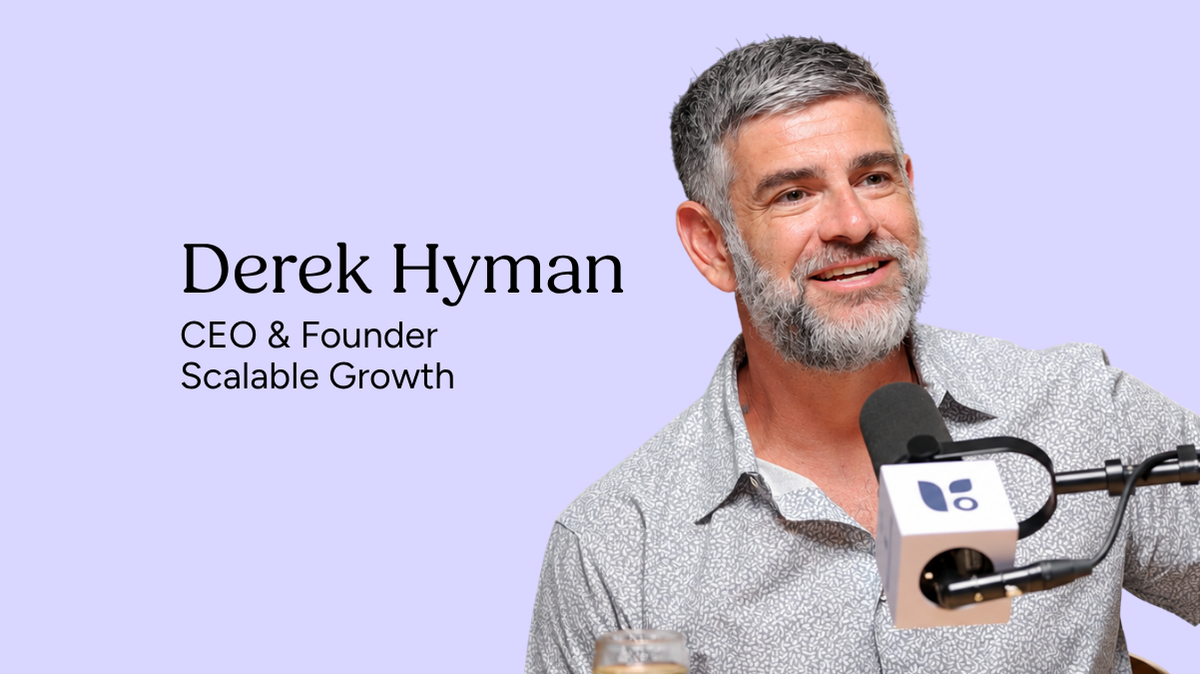
Derek Hyman spent almost a decade running digital marketing in-house at one of the largest treatment providers in the country. He had 80-plus people, 25 websites, and millions of dollars a year in marketing spend. That vantage point gave him a number most operators never get to see about their own business.
"We understood that only 6% of the traffic on the collective set of websites that we ran drove 80, 85% of revenue."
Pareto, essentially, but sharper. And it reframes the entire job.
"My philosophy was always, if we're responsible for generating more leads, impacting more lives, hopefully getting more people to reach out, we gotta really hone in on that 6%."
That insight is what eventually pushed him out the door. He wanted to bring it to smaller programs that would never have that budget, and he wanted to answer a question about himself.
"I also wanted to prove to myself that it wasn't just luck of the draw because we had this big marketing budget. Could we actually positively influence growth on a website that didn't have the authority that some of these websites had?"
He started Scalable Growth unofficially in 2020, went all in by 2022, and sat down with Recovery Reach host Cliff McDonald to talk about agency turnover, why he tells prospects to keep their current partner, the $42,000 website problem, and the clients he turns down.
From public health to performance marketing
Hyman has a master's in public health. He went into it wanting to influence people positively at a population level, met his wife in the program, and then did very little with the degree for a while.
He landed at a large behavioral health provider knowing nothing about digital marketing and assuming marketing was fluff. Brochures, brand, the half-your-budget-is-wasted joke.
Then the light went on.
"When I realized that good performance marketing was all data-driven, a light bulb went off in my head," he said. "I like to understand the way things work. If you do A, B, and C, these are the outcomes you're gonna get, and if you don't, what's gonna happen?"
He drew the line straight back to his training. In public health you implement a program to change something in a community, and you define your outcome of interest up front. Marketing runs the same loop. You put in dollars, time, and energy, you measure the outcome, and you reinvest where it worked.
His scope in-house covered content, SEO, product development, UX, design, and, for a while, paid media. That last one ended in a way only people in this field will recognize: when LegitScript certification changed the paid landscape, he flew to Nashville to lay off his paid media lead.
They work together again today.
"I don't wanna be an agency"
Early in the conversation, McDonald explained why he refuses to call behavioral health an industry. A lead is a struggling human. A conversion is someone admitting to treatment. Hyman picked up the thread and applied it to his own category.
"I don't like to brand myself as an agency. I wanna be a growth partner for treatment programs."
McDonald's parallel: he does not want anyone calling Recovery.com a directory. It is a marketplace.
The naming matters to Hyman because of what it commits him to. There are fast ways to move numbers in digital marketing, and more of them now than ever.
"Today with AI, there's a lot of ways that you can win today, but I personally believe are gonna hurt you long term, because you're trying to cut corners and win today. So Scalable Growth is intentional. If it's done right for your business, you're gonna persevere through algorithm updates, you're gonna persevere through whatever the AI model is that's the hot topic today."
Why agency turnover is so high, from someone who used to do the firing
McDonald raised something he sees constantly in the agency partner program: providers on their fifth agency in three years.
Hyman has been on both sides of that churn. In-house, he hired agencies, and he fired them, for the same reason everyone does. It never felt like an actual partnership. The person who understood the business perfectly in the sales conversation disappeared after onboarding, replaced by someone more junior.
"You said that you were gonna be a great partner for us. Here's all the reasons why I don't feel like there's the partnership happening."
The other half of the churn, he said, is agencies promising outcomes on timelines that digital marketing cannot deliver. Depending on the market, the site, and a dozen other factors, results take time. The job in the meantime is education.
"Our job is to educate you along the way so that even if it's taking time, we can lay out that roadmap on what growth is gonna look like."
He calls what he encounters in most first conversations "PTSD from prior agencies." And here is the part that should make other growth partners uncomfortable: he is an advocate for not switching.
"The first three to six months are building that relationship. There's a lot of effort that goes into the beginning."
McDonald catalogued the real cost of a switch for the provider: opportunity cost, time cost, learning cost.
So Hyman does something that almost nobody in the sales conversation does. He tells prospects their current partner is doing a good job.
"I've actually told a few people who have come to me, your partner's doing a good job. Here are some things I would recommend you change. I don't wanna just take business away if I think they're doing the right thing."
The inverse is also true, and he does not soften it. If he looks at a site and the fundamentals are missing, what he called basic blocking and tackling, his advice is to fire that person or team tomorrow.
"I'm an open and honest book, and I will not take business if I don't think it's the right thing to do, but I will also tell people that I don't think your investment in digital marketing is gonna pay off for you."
His tagline captures the posture: fresh perspective, scalable growth. Sometimes the fresh perspective is just confirmation that things are fine and need more time.
McDonald's read on the strategy: it builds trust, it builds brand, and it is value creation, because every other agency in the rotation has thrown the incumbent under the bus to win the account.
The $42,000 website
McDonald offered an analogy from his own summer. He got four bids to paint his house. They came in at roughly $9,000, $12,000, $14,000, and $42,000. The $42,000 outfit is visibly busy in his neighborhood.
Two possibilities. They do great work. Or a lot of buyers in that neighborhood are not collecting multiple bids.
Hyman thinks website builds have the same problem, and not just in this field.
"Website build companies charge way too much money to build a website that looks and feels good," he said. "The sticker prices to go make a new website that has nothing to do with its ability to perform is crazy to me. These high price tags for something that produces zero ROI is wild to me."
He is not dismissing design. Scalable Growth has built sites from scratch for partners who needed them, and he is explicit that good design matters for conversion rate optimization. The issue is sequencing.
"The look and feel of your website is only important if you have high intent traffic, the right people on your website."
Then the line that should be printed and taped to a few conference room walls:
"We work on some sites that I don't like to look at, but they perform well. We work on other sites that look better than the average, and it's hard to get them to perform."
His framing on the spend: there is a time and place to invest the $42,000 to repaint the house, but if you can get a good outcome for less, take the difference and put it into something that actually generates growth.
The ideal client, which was an accident
Scalable Growth works exclusively in behavioral health. Hyman's view is that good digital marketing is good digital marketing and the tactics travel, but the market knowledge is the moat, so they do not chase work outside the field.
The more interesting pattern was not planned.
"Our ideal customer doesn't actually have an in-house team. It was not intended that way."
The reason traces back to managing 80 people with different skill sets and watching how hard it is to get an organization to execute a strategy even when you have the data behind it.
"You can believe your strategy, you could have the data to support it, but getting folks to follow suit isn't necessarily going to happen easily."
Where Scalable Growth is brought in alongside an internal team that was running the sites beforehand, and is still held accountable for the results, the collaboration often does not go the way it needs to. McDonald named the failure mode: finger-pointing and unclear ownership.
What Hyman wants instead is closer to a full outsource of the marketing function, and he frames it in terms of what it gives back to the operator.
"I want the CEOs of these companies to have one less thing to worry about. Especially if they're smaller, they're wearing a finance hat, an operational hat, a marketing hat. If I can take one thing off their plate, and they can trust and rely on me and my team to deliver, then that makes me happy."
The clients he turns down
This is the part of the conversation that separates Hyman from most growth partners in the space.
"The last thing I wanna do is to be associated with a program where they get this hyper-growth, but then their ratings and reviews start to go down, their reputation starts to go down, and it was a symptom of us just being good at our jobs but then the clinical program wasn't good."
So the team screens for clinical quality before signing, and they have said no.
His second reason is internal, and it is one more growth leaders should probably think about. His team looks at these websites all day, every day. If they start reading them the way a consumer searching for treatment would and come away with a bad feeling about the program, that is a problem he owns.
He credits the ability to be selective to an early stretch of hyper-growth, and to what he did with it. In year two, instead of pressing the accelerator, he built internal infrastructure.
"Marketing shouldn't be a stressful thing. I know marketers are the first ones to be held accountable for lack of business growth, but I believe there shouldn't be a fire to have to put out if you do digital marketing well. What we do today isn't meant to have an impact today per se."
His question for his own business: how do we build this in a way that we can maintain that sense of peace?
Growing without a business plan, and the loneliness that came with it
Hyman had no business plan. He had a problem statement, which he argues is the right place for any business to start.
He also had no sales experience, and no B2B marketing experience. What he had was a network and a reputation, and the referrals came faster than he expected.
"The first year my CPA called me and she was like, did you get a round of investment? Did you put money into the business? And I was like, no, this was all just organic growth."
That growth rate has not repeated every year since, by design.
Asked about a difficult season, he did not reach for a failure story. He does not have one yet, and said so. What he named instead was the isolation of the first year and a half.
"It used to be a team of people with different opinions where you could go validate and test your hypothesis, or the stability of a W-2 organization," he said. "If you don't perform well as a small business, you don't have a small business anymore."
He had read about how lonely it gets. Reading about it does not do much.
"At the end of the day, you gotta live it. I'm an experiential learner. I just jump in and figure it out."
The other surprise was everything the job turned out to include. Finance, tax law, accounting principles, none of which he studied, none of which is relevant to the day-to-day work of growing client websites.
McDonald, who bought a restaurant as his first business after finishing his MBA, recognized the shape of it immediately. Overnight you are HR, finance, strategy, and operations. He called it the best internship you could ever have if you want to work in business.
Hyman's antidote to the isolation is deliberate and low-tech. Former executives from his in-house days have come back and hired Scalable Growth. He keeps a network of people he genuinely enjoys, several of whom he sees at his coffee shop and catches up with for 20 minutes at a time.
"They don't know our space, but they've built successful businesses, and those candid conversations are super helpful."
Overrated: AI
Hyman did not hedge.
"I hate to say it, but AI is overrated."
He uses it every day, finds it fascinating, and is clear he is not anti-AI. What exhausts him is the volume of conversation about it relative to the substance underneath, which he compared to the internet in the 1990s before any governance caught up to it.
His mother was a math teacher, and her line does the work here.
"A calculator's a great tool, but if you type in the wrong numbers, you're gonna get the wrong answer."
He added that in his daily use, the first response is never the meaningful one. It takes human intervention to get an output worth anything.
The practical problem for treatment marketing is economic. Anyone can generate a decent, readable piece on alcohol detox in seconds. It is cheap, and with premiums rising and operating margins under pressure, cheap is attractive.
"It's very generic," he said. "AI just aggregates a bunch of information together and creates a generic piece of content. The whole goal of digital marketing is to separate yourself from everybody else out there."
Scalable Growth still writes all of its content by hand, and Hyman's stated condition for revisiting that is Google saying clearly that AI-generated content is fine.
McDonald connected it to something he says often as a person in long-term recovery: the opposite of addiction is not sobriety, it is connection. Authentic human connection specifically.
Underrated: the entire patient experience
Asked what behavioral health leaders should be thinking about, Hyman went to the one thing that spans marketing and clinical.
"They should just be solely focused on their patient experience."
His argument is that the user journey does not start at admissions. It starts the first time someone encounters your brand, which is usually in a moment of crisis, at a search bar or an LLM.
"That first experience with your brand, your website, your ad, your business development team, should be tied through the entire journey, even through your alumni program. It should be tied through your lead nurturing process, your admissions team, your front door, whoever's doing the intake, and then hopefully your clinical program follows suit."
He sees two recurring failure profiles. Operators with clinical backgrounds who care deeply about the program and are weak at the front door, the welcome, the nurturing of a lead who has not decided yet. And business-minded operators who know where every dollar goes but treat the welcome email and the intake as secondary because the admission is already booked.
The metric argument underneath it is one every growth leader in this field should sit with.
"We often look at CPA, which is obviously an important metric. But if that person AMAs on day two, you're not going to get the revenue you were expecting from that admission."
Given relapse rates and the reality that people return to treatment, the long-term value of a patient relationship extends well past discharge, and it is built or destroyed by the coherence of the experience.
Which is where his AI answer comes back around. Even though he called it overrated today, he is clear about the direction.
"At some point, it's gonna be a primary search channel, whether it's next year in 2030 or 2050."
And when it is, the requirement gets harder, not easier.
"That information needs to be cohesive. What the person on the phone's saying with what your AI assistant's saying, with what your intake nurse is saying. If there's ever a degradation in that journey, you're just doing a disservice to the people you're trying to serve."
Our Promise
How Is Recovery.com Different?
We believe everyone deserves access to accurate, unbiased information about mental health and recovery. That's why we have a comprehensive set of treatment providers and don't charge for inclusion. Any center that meets our criteria can list for free. We do not and have never accepted fees for referring someone to a particular center. Providers who advertise with us must be verified by our Research Team and we clearly mark their status as advertisers.
Our goal is to help you choose the best path for your recovery. That begins with information you can trust.